
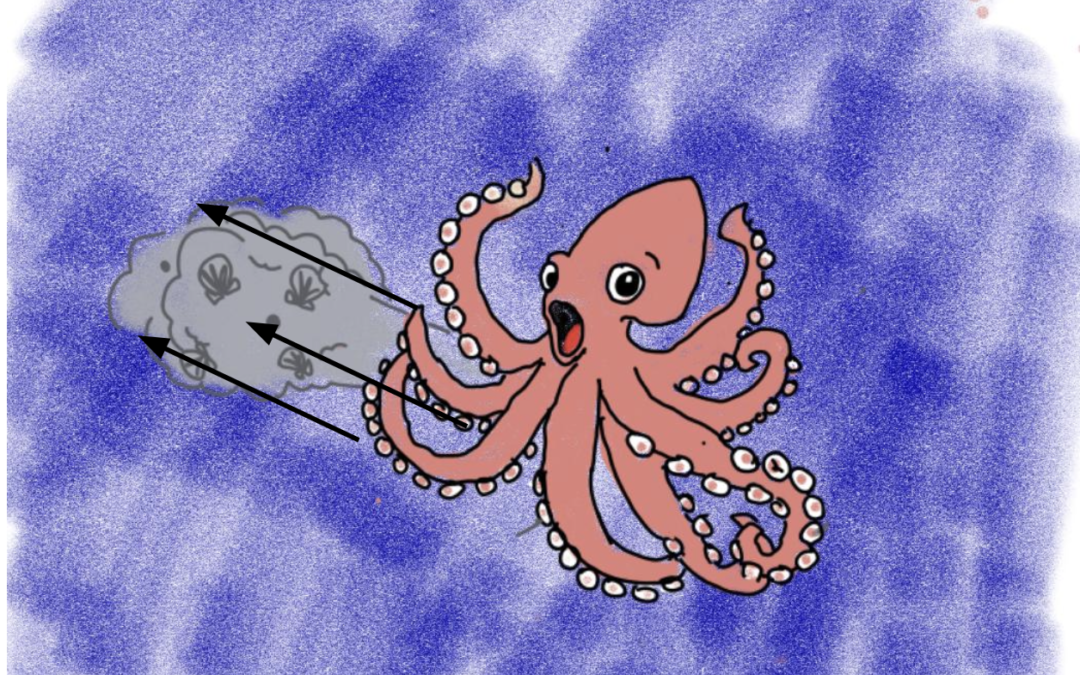
Have you ever felt the urge to hurl an object, or behave in an aggressive manner towards something that annoys you? Aggressive behavior is shown throughout all animals including humans, but the occurrence of “throwing” objects is not as common of a behavior within animals. Commonly confused with ballistic motion, or the momentum of free moving manipulated objects, throwing an object requires aim and attempted precision. Throwing is most commonly seen in humans, though the assumption now is that throwing can be seen in wild Octopus tetricus.
Scientists have studied how the behavior of throwing with aim has been seen in other animals such as primates, elephants, and mongoose, and birds. Because this is mainly seen in humans, it leads scientists to believe that it has an important role in hominin evolution. The goal of this study is to determine if an octopus throws an object as a way of targeting other octopuses. Along with this, they attempt to understand the difference between throws that hit other octopuses, and throws that do not.
Researchers performed their experiments in a southern part of Jervis Bay, NSW, Australia, at a field site at 17 m depth. To collect their data, they set up numerous stationary video cameras set up on tripods covering the field site through the years of 2011-2018. Data was collected by reviewing videos from certain sections of the recording, which obtained numerous examples of throwing behavior. To minimize disturbance, they did not identify sexes through anatomical identification, rather through behavioral differences. They categorized the materials that were used to throw (shell, silt, algae), along with the context of the throws (eating, den maintenance, and interaction). They defined a “hit” as when the object being thrown makes contact with another octopus. Rather than using their arms to throw objects, octopuses will gather material, then expel the material out with pressure.
Researchers found evidence of octopuses hitting others with their throws often enough for it to be considered as intentional targeting, particularly in scenarios involving mild aggression between the two. Consequently, throws and hits have social implications, and affect the interactions between individuals. From this it is decided that octopuses may be one of the animals that propels objects, and even one of the few animals that propel these objects in the direction of others.
Godfrey-Smith P, Scheel D, Chancellor S, Linquist S, Lawrence M (2022) In the line of
fire: Debris throwing by wild octopuses. PLoS ONE 17(11): e0276482.
