
Evidence has shown that spiders create webs in order to catch prey. Some spiders have unique web designs while others look quite similar. Many have looked into what causes the differences in webs but few have found concrete answers. The similarities across evolutionary lines led scientists to wonder if there is a structural advantage to certain webs and that is why they cross species. Some of the differences lie with different appetites and what prey is caught in the webs, or the size of the spider making the web, or the environment they live in. But across all of these spiders and webs one thing remains consistent, they build them as homes and places to catch prey.
Pirate spiders have a different way they catch their food. The prey of pirate spiders is other spiders. One way they do this is by infiltrating the prey spider’s web and moving ever so slowly that they may only move a few centimeters in one hour. Then, once close enough, the pirate spider will attack the web owner with a rapid bite that can immediately kill or paralyze its prey. Another kind of pirate spider (G. siquirres) will create one line of silk to mimic the mating ritual of one of its prey, and lure a prey straight to its mouth. But the specifics of these lines of silk had yet to be studied.
Gilbert Barrantes, Laura Segura-Hernández, and Diego Solano-Brenes wrote a paper on their observations of pirate spiders (G. siquirres) at the Tirimbina Biological Reserve in Costa Rica. They did not interfere with the spiders at all and merely observed and recorded what they found. They first found long lines of dry silk extending toward the ground, which is common among spiders to give them access to the ground floor. But these silk lines started from a home base called the “retreat.” The retreat of the pirate spider was made of very sparse lines of silk that connected to leaves and branches. The length of these dry silk lines to the ground was measured as well as the angle they contact the ground.
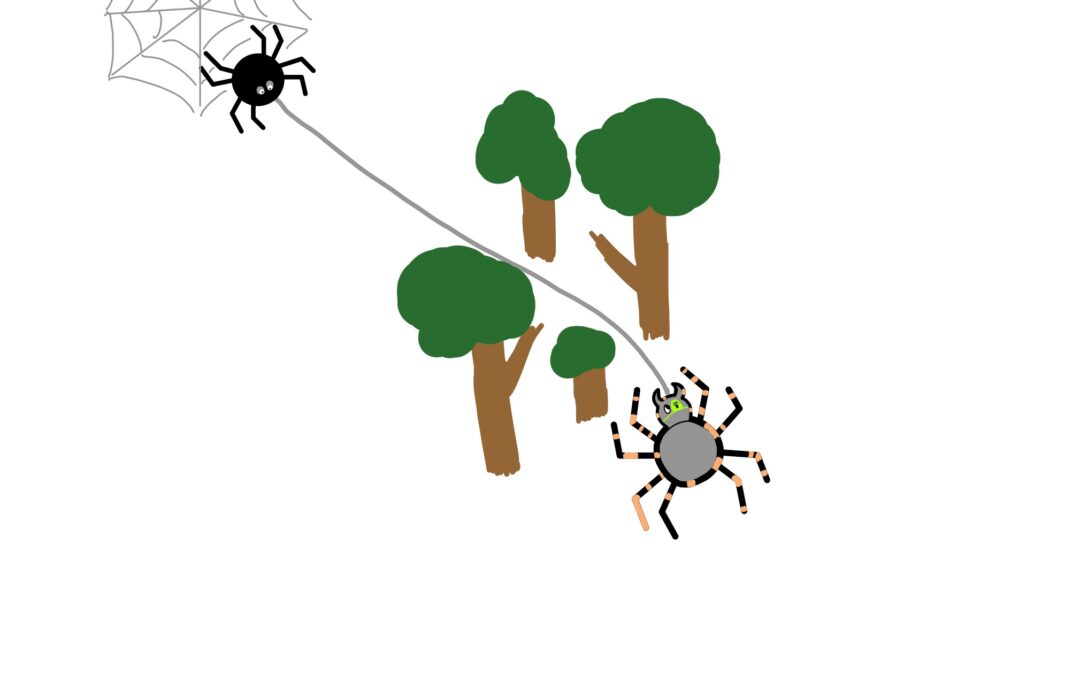
The way many spiders begin forming their web is by dropping a line of silk in the wind, and allowing it to attach to an object, then continuing to build it off of there. The pirate spiders take advantage of this and create a line of silk for the purpose of other spiders dropping a line of silk onto theirs. These other spiders will then travel along their line where the pirate spider will be waiting to attack and feed on its prey.
This kind of web making is new and not well studied. It has only been reported within the pirate spiders and none others. There may be other spiders who eat spiders, but not like this. These spiders lure their prey in by pretending to not exist and striking when they least expect it. This is a new evolutionary concept that had not appeared before. Not only do these spiders create webs so that other spiders can climb them, they also run very very fast along their silk lines to catch their prey. The other pirate spiders move very slowly as they are hidden in the prey web.
References:
Barrantes, G., Segura-Hernández, L., & Solano-Brenes, D. (2023). A novel prey capture strategy in pirate spiders (Araneae: Mimetidae). Animal Behaviour. https://doi.org/10.1016/j.anbehav.2023.07.001
