
Like humans, almost all animals face heat stresses in the environments in which they live, over both brief and prolonged periods of time. Honeybees are no exception to this group, as the species has devised certain ways of cooling themselves, as well as the colonies that they live in during times of high temperatures and heat stresses. Some of these mechanisms include fanning their wings and collecting water. Honeybees are also a unique species because of the social interactions that they have with members of their own species, living alongside other honeybees in large colonies. In these colonies, each honeybee takes on a specific role, which is one that changes during periods of heat stress. In a recent study, by Jhawar et al. (2023), honeybees were tracked using automated technology in order to examine how their behavior would change, both individually and within their colony.
In order to study further the changes in behavior in honeybees that occurred when heat stress was added to their colony and the surrounding environment, colonies were heated for three hours in the morning and afternoon on five randomized days over a month-long span. The temperature of the hive was increased by approximately 20 degrees celsius in order to ensure that the increase in heat would cause behavioral changes. In order to track the bees and their behavior, both before and during the periods of heat stress, automated tracking systems were used on tagged bees, allowing for nearly 3,000 honeybees and their responses to heat stress to be studied. As such a vast number of these honeybees had their response behaviors studied, it was found that these organisms often created clusters in which they partook in similar activities, reinforcing the idea of collectively working together for the sake of the colony. Given the relatively short time of the extreme heat stress applied to the colony during the experimentation period, Bees were able to return to their normal behaviors that had been observed during the control days at a relatively quick rate.
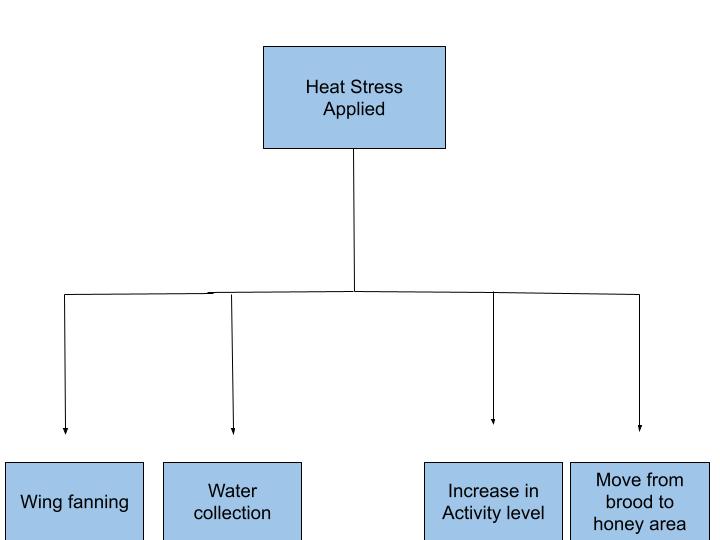
Results largely showed that behavior did change both in individual honeybees, as well as in the clusters that had similar roles within the colonies to which heat stresses were applied. With this increase in behavior, it can also be said that a vast majority of the honeybees had increased activity during the periods of heat stress, and behaviors in the colony, as well as outside of it, became more diversified, as honeybees that typically had one role took on more during the periods of colony heating. Additionally, location in the colony during heat stress also had a bearing on the activity and behavior of the honeybees. Honeybees in the brood area, an area integral for honey bee development, often moved towards the areas of the nest containing honey, while honeybees close enough to the exit often departed from the nest in an attempt to cool themselves down, as well as retrieve water that could be used to cool down the colony. Water brought back into the nest, or that was already available within the colony, was dispersed by bees in clusters that were not able to exit the colony, but could still move freely around the colony in efforts to cool the temperature by way of water. Other honeybees who were within a close proximity to the exit of the colony took part in wing fanning, which served to increase airflow within the colony and flush out some of the warm air. In terms of honeybee behavior within the colony, working together, both within clusters and efforts containing multiple clusters occurred. One of the most interesting phenomena that occurred during heat stress was the effect of “task switching”, during which bees would frequently change from one task to another while combating the heat stress in their colony. While this frequent task switching did take place in the colony during control periods, this effect was magnified during heating periods, perhaps due to the fact that more activity needs to take place during these periods to actively cool the colony.
Age also played a role in the behaviors exhibited by the honeybees in this colony, as certain clusters had different median ages, and thus different proximities to the exit and non-exit areas. Further research in the field of honeybee age and its effect on behavior, specifically during times of heat stress, was suggested in this paper in order to examine the proportion of different behaviors in different age brackets. Other areas of possible research in the future include swapping areas within the colony, as well as cluster location, to see if this has any effect on the behavior of honeybees, and whether or not the trends seen in the controls of this experiment will be supported after change in the colony.
Overall, this study on honey bees and their behavioral changes, both as an individual and as a part of a collective group, when heat stress is applied to their colonies. Some of these behaviors aimed at cooling down the honeybee colony included dispersion of water, fanning of wings, and increased activity as movement increased throughout the colony. Through this study, many parallels can be drawn between the behaviors of these honeybees and humans, despite differences in morphology and way of life, from their need to maintain homeostasis in the form of a cool living environment, as well as their ability to exhibit teamwork in order to reach this goal of reacting to heat stress.
Jhawar, J., Davidson, J. D., Weidenmuller, A., Wild, B., Dormagen, D. M., Landgraf, T., Cousin, I. D., Smith, M. L. (2023). How honeybees respond to heat stress from the individual to colony level. Journal of the Royal Society Interface, 20(207), 20230290. https://doi.org/10.1098/rsif.2023.0290
