
With the importance of the natural world staying interconnected, it is no wonder that animals develop their own “language” to communicate with each other and survive environmental challenges. While some incorporate various signals for social cues such as sending a voice message, releasing a certain type of chemical, or prodiving information through touch, wolves use visual communication to convey their behavioral patterns to each other. According to recent research, wolves are able to maintain cooperation through recognizing each other’s facial expressions which signal their emotional states and intentions behind them. These species are known for their competitiveness which makes maintaining the balance between their play fighting and real fighting crucial for living communities. Both of these behavioral patterns enable wolves to maintain social hierarchy and encourage rewarding interactions, but how does one learn whether that face signals “let’s be friends” instead of “be ready for attack”?
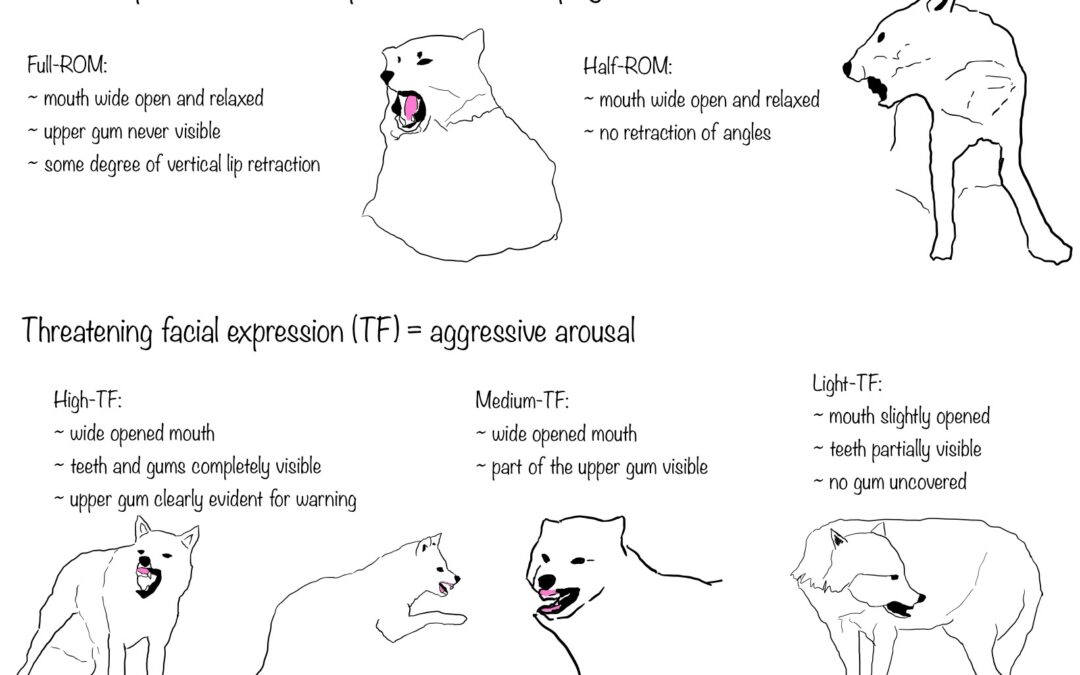
Researchers gathered video data from 38 wolves from three mixed-age captive groups (Canis lupus arctos, C. l. lupus, C. l. occidentalis) to analyze the changes in facial expressions during aggressive and playful times. One of the main challenges for accurate facial perception in wolves is that both of those behaviors involve an individual opening their mouth and showing teeth. Based on the video recordings, the researchers were able to identify distinct features in facial expressions and differentiate between three playful faces and two threatening faces, depending on the intensity of the interaction.
Wolves display playful behavior by eliminating any sense of dominant attitude as if inviting the playmate to engage in a positive interaction by pushing, biting, and rolling. The species sends this type of signal by maintaining a relaxed open mouth that never reaches the intensity of a bite or close proximity to have any contact with the skin of the playmate. In contrast, the aggressive patterns in wolves are portrayed by a high level of directionality to attack the victim until the latter responds with submissive behavior and rarely counter-aggressive behavior. In those cases, the animal maintains a threatening facial expression with bare teeth and curled lips, while revealing a light spot on the top of its gums as a warning sign of escalating danger.
This research brings a new glimpse into the communication and signal systems in wolves based on their facial expressions. While both threatening and aggressive behaviors involve similar motor patterns, it is captivating to learn about their distinct features. At the same time, there is something extremely beautiful about being able to recognize those little details and what they mean in the animal world – a standardized set of behavioral elements to understand the language of wolves and recognize whether they are willing to be your friend.
Bibliography
Maglieri, Veronica, et al. “Tell-Tale Signals: Faces Reveal Playful and Aggressive Mood in Wolves.” Animal Behaviour, vol. 214, no. Volume 214, Aug. 2024, pp. 1–9, https://doi.org/10.1016/j.anbehav.2024.05.013
