
Sound is incredibly important to animals, humans included. Its applications are extensive, such as warning calls to signal danger, sweet purring of a cat to express happiness, a baby’s cry for their mother’s attention, music shared amongst a community, and much more. Applications are not the only broad aspect of sound; the range of pitches a sound produces also encompasses a wide array of frequencies. Take Ariana Grande for example – she is known for her massive vocal range, which spans over four octaves. This is absolutely extraordinary for a human; a range of her size is almost unfathomable. It may be a surprise to hear that some animals can vocalize in ways that make her whistle notes seem pretty unimpressive. Amongst the animal kingdom, no mammal can quite compete with bats – they can vocalize through six to seven octaves, producing the highest frequencies of any animal in the kingdom!
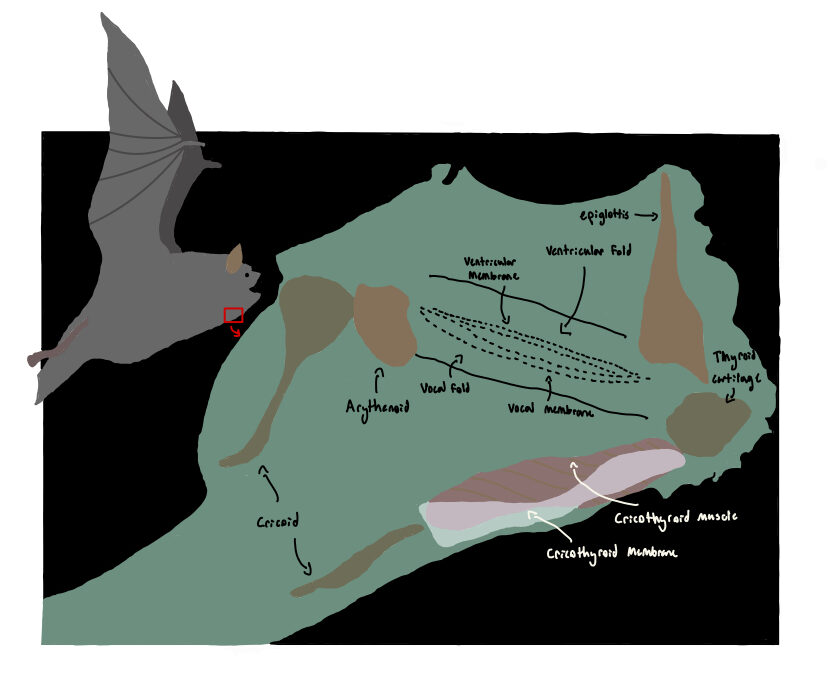
Bats use their vast ranges to find prey via echolocation and communicate with one another. These flying puppy-like creatures are like little Avengers and their superpower is “seeing” with sound, more formally known as echolocation. They make sounds that bounce off of objects and boomerang back to them. The echos give them tons of information on the location, distance, and shape of objects in their path. These sounds come from their larynx, or voice box, that has cords that resemble guitar strings amongst other special structures, such as membranes and folds. These work together to create anything from “death metal growls” to inhumanly high screeches. In combination with powerful flight abilities and rapid buzzing, high-pitched echolocation allows bats to feast on fast moving insects throughout the night with ease. Notes that reside in the depths of their range, similar to human throat singing, are reserved for social calls. Multiple unique structures in their larynx are thought to cause their tremendous versatility in sound. But, this is difficult to measure because their vocal folds move very fast – almost too fast to see on video. No concrete evidence of these special structures aiding in vocal production existed until Jonas Håkansson and other scientists alongside him studied Daubentin’s bats.
Håkansson and his team dissected five bats and examined their larynges to visualize the vocal and ventricular folds, or little flaps in their throat, and found specialized thin membranes on top of the vocal folds. They then used super high speed video to film vocal folds in Daubentin’s bats. Afterwards, they examined networks of neurons, or brain cells, to understand how the brain controls the motion of the folds and membranes. These became the very first true observations of the flow-induced, self sustained vibrations that produce echolocation. Essentially, fluid flows past the structure and creates a vibrational force. These vibrations then match the natural frequency of the structure and amplify. They found that this happens best with the least amount of pressure necessary, but with said pressure changing quickly.
After these scientists analyzed their findings, they started putting two and two together, figuring out the role of these structures for each kind of sound. Thin membranes on the vocal folds vibrate by themselves and produce the super high frequencies they need to “see” in the dark via echolocation. Smaller membranes point downwards and help push out those deeper sounds. The ventricular folds extend this lower range for “talking” to other bats.
There are multiple signs that point to these unique features evolving to favor the fastest, highest pitched frequencies. This combination helps them find fast-moving bugs for food at night, when they hunt without seeing with light. The vocal membranes evolved to be very thin and small in order to have space to vibrate as much as possible. Their muscles changed as well; they became thicker and weaker. In addition, the parts moved by these muscles became smaller. This combination allows their calls to happen more frequently and faster. Lastly, an extra membrane formed in the space left by their thyroid, a gland that produces hormones, since its size has been reduced over generations. This creates a more flexible throat, allowing for quick calls. Unfortunately, the role of more peculiar membranes is still unknown, as some of them had to be removed in order to film the larynx. More research must be conducted to answer these questions and tell the entire story.
Håkansson, J., Mikkelsen, C., Jakobsen, L., & Elemans, C. P. H. (2022). Bats expand their vocal range by recruiting different laryngeal structures for echolocation and social communication. PLoS Biology, 20(11), e3001881.
