
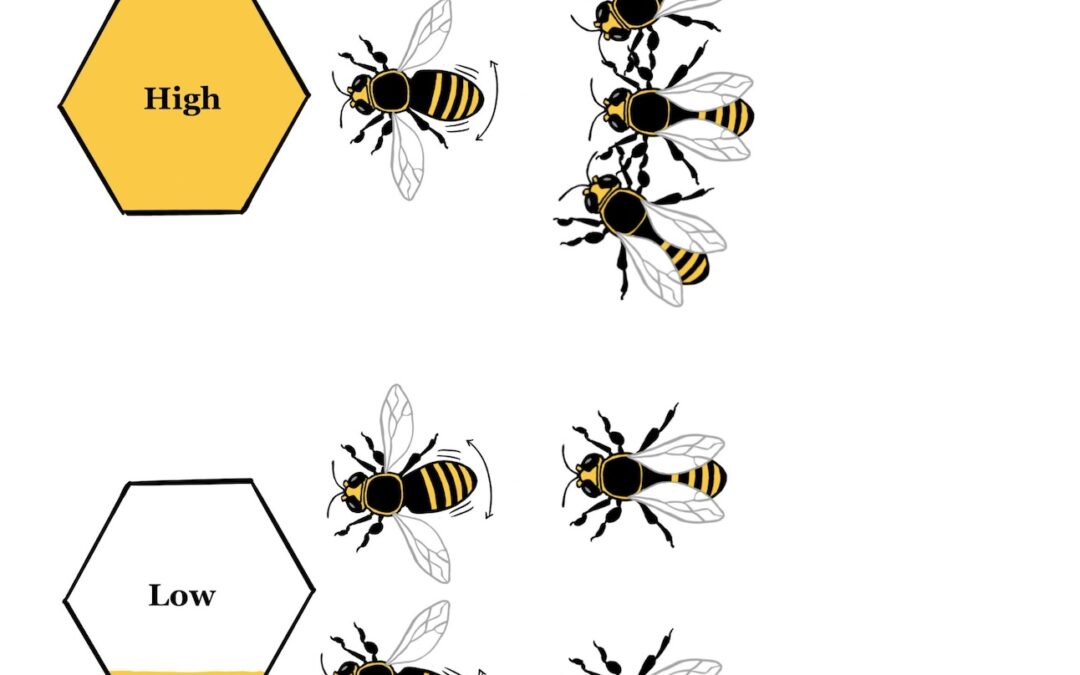
We’ve all heard that bees are fundamental pollinators—they’re responsible for approximately 30% of global human food production for crying out loud (Khalifa et al., 2021)! Yet for all their heroics on agricultural crop and wildflower pollen propagation, we tend to forget about their other, more stylish hobby, dancing. Bees, just like several organisms including avians, lizards, and human beings, use dance to communicate. Yet while a male of the aptly named Vogelkop superb bird of paradise may get his boogie on to woo the ladies, bees such as the honey bee use waggle dances to tell their hive-mates about where food is (Aminoff & Daroff, 2003; I’Anson Price et al., 2019).
It works like this: when a forager honey bee returns to her hive after finding nutritious nectar or honeydew, she may move in a figure eight motion with a straight run segment in the middle. During the run, she rapidly waggles. More waggles means more distance between the food and the hive, and the angle of the run, relative to straight upward, indicates the direction of the food relative to the sun’s current position in the sky. Amazingly, because it’s quite dark in the hive, other bees rely less on sight to watch their peer’s masterpiece. Instead, dance followers discern the pattern through sound, and by touching the dancer with their antenna (Aminoff & Daroff, 2003).
Yet, in opposition to scientific documentation on how bee dance communicates information, little has been uncovered about how a hive’s food storage amount (honey) affects bee dance. Specifically, the frequency of these waggle dances, and the amount of bees that tune into the performance. This is of particular importance considering the recent downward trend in honey bee populations as a result of human impact on bee food availability through pesticides and habitat loss (MacInnis et al., 2023; Wu et al., 2024). To our rescue however, a recent study titled Low food stores affect dance communication and health-related gene expression in honey bees has sought to fill this knowledge gap by analyzing the honey bee Apis mellifera.
The researchers hypothesized that if food storage becomes low, there would be a higher frequency of dancing and dance watching in these bees than if food storage was high (Wu et al., 2024). This is because if a hive has less food stored up, it becomes more necessary for the bees forage outside the hive to refill those stores and to avoid the possibility of hive starvation. If more bees are going out and foraging, according to the researchers, the bees would optimize this process by sharing more information to each other about where food is, instead of starting their search from scratch every time.
To test this idea, the researchers created hives with a glass wall in proximity to the bees’ natural habitat. The top layer of the hive was set up and filled to be the main honey storage space. After six days of allowing the bees to become familiar with their new home, the researchers split the hives into two groups where they exchanged the top layer either with an empty storage space, or another honey filled storage space. While replacing one filled space with another might seem redundant, it was done to make sure the act of swapping the storage spaces themselves didn’t change the bee’s behavior. They then filmed the bees and their activities, watching for waggles as their queue for dancers, and other bees touching wagglers with their antenna as queues for followers (Wu et al., 2024).
What they found was a 60% increase in the frequency of dances in hives with little to no honey compared to hives with high honey stores, which matched their prediction (Wu et al., 2024). This result is further supported by other research which has shown that in hives with low food storage, honey bees will start searching for food at a younger age (Schulz et al., 1998). This would increase the total number of exploring bees at any given time, and therefore the total number of bees that would find meals and then report on them by dancing.
What did not match their prediction however, was a 20% decrease in followers per dance in honey-less hives (Wu et al., 2024). While this result may seem counterintuitive, the researchers suspect it might be because the number of total followers could have stayed the same, while the number of dancers increased. This means follower numbers would be spread thinner to have an equally sized audience per dancer. An alternative explanation provided draws on other research which states that when hives become more starved, honey bees switch to a foraging strategy where they look for food without information from other dancers. This is to avoid waiting and searching for dancers, which wastes time that could ultimately be used to find and collect food (I’Anson Price et al., 2019). Not relying on other dancers also means less foragers go to the same food source, diversifying and increasing food’s availability to the hive (Wu et al., 2024).
To end, while findings like these provide fun insight into the everyday lives of our favorite pollinating performers, we must also recognize the significance of studies like these on making us understand the impact we have on the lives of animals like the honey bee. Only by understanding these creatures can we take the necessary precautions to protect them, for their sake and our own.
References:
Aminoff, M. J., & Daroff, R. B. (Eds.). (2003). Encyclopedia of the neurological sciences (1st ed). Academic Press.
Eyer, M., Neumann, P., & Dietemann, V. (2016). A Look into the Cell: Honey Storage in Honey Bees, Apis mellifera. PLOS ONE, 11(8), e0161059. https://doi.org/10.1371/journal.pone.0161059
I’Anson Price, R., Dulex, N., Vial, N., Vincent, C., & Grüter, C. (2019). Honeybees forage more successfully without the “dance language” in challenging environments. Science Advances, 5(2), eaat0450. https://doi.org/10.1126/sciadv.aat0450
Khalifa, S. A. M., Elshafiey, E. H., Shetaia, A. A., El-Wahed, A. A. A., Algethami, A. F., Musharraf, S. G., AlAjmi, M. F., Zhao, C., Masry, S. H. D., Abdel-Daim, M. M., Halabi, M. F., Kai, G., Al Naggar, Y., Bishr, M., Diab, M. A. M., & El-Seedi, H. R. (2021). Overview of Bee Pollination and Its Economic Value for Crop Production. Insects, 12(8), 688. https://doi.org/10.3390/insects12080688
MacInnis, G., Normandin, E., & Ziter, C. D. (2023). Decline in wild bee species richness associated with honey bee ( Apis mellifera L.) abundance in an urban ecosystem. PeerJ, 11, e14699. https://doi.org/10.7717/peerj.14699
Schulz, D. J., Huang, Z.-Y., & Robinson, G. E. (1998). Effects of colony food shortage on behavioral development in honey bees. Behavioral Ecology and Sociobiology, 42(5), 295–303. https://doi.org/10.1007/s002650050442Wu, Y., Peng, T., Menzel, F., & Grüter, C. (2024). Low food stores affect dance communication and health-related gene expression in honey bees. Animal Behaviour, 216, 131–139. https://doi.org/10.1016/j.anbehav.2024.07.017
