
By Collyn Carpenter ’22
Bottlenose dolphins are known to be very social and intelligent organisms in the animal kingdom. Similar to many other types of organisms, bottlenose dolphins develop social relationships amongst each other for a number of varying reasons such as: hunting, sex, mating, dominance, etc. Researchers have observed that the different hunting techniques bottlenose dolphins use can affect their social status amongst their group.
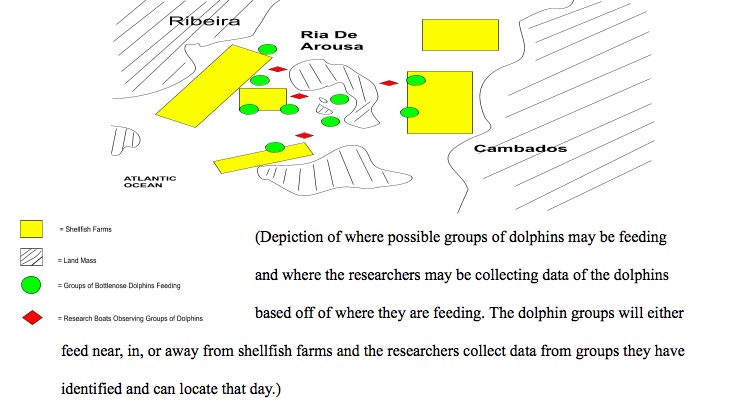
A study published on 09 April in Behavioral Ecology found that bottlenose dolphins in the Ria de Arousa (Galicia, northwest Spain) developed different social patterns within the same groups based on how individuals hunted for prey. It was observed that dolphins that hunted in human-altered areas (shellfish farms) did not develop strong associations with others. Whereas
dolphins that did not hunt as frequently within the shellfish farms displayed stronger associations with others and displayed less interindividual competition compared to dolphins that hunted more frequently in the shellfish farms. This information could suggest that over time the dolphins could segregate into separate groups based on hunting behaviors. Also, this information gives greater insight into how human activities in marine systems affect the evolution of bottlenose dolphins.
The study was conducted for three years on research vessels from April 2014 to November 2017. Research was done during the daylight hours when conditions were fair and did not include: bad visual conditions, rough waters, poor weather, etc. A group of bottlenose dolphins was defined as one or more dolphins performing the same behavioral activity within a 100m radius. The date, time, and GPS location were recorded each time a group was observed as well as whether or not the group was within the area of the shellfish farms. Dolphins were identified using natural marks seen on their dorsal fins and these marks were photographed to ensure proper identification. Dolphins with easily distinguishable features were used for data purposes for this study. A “farm foraging rate” was created and used to calculate every time a dolphin hunted in a farm area compared to the amount of times the dolphin hunted in total including times outside of farm areas. Dolphins that were seen together in the same group in a single day were considered to be associated. In order to ensure accuracy, only dolphins that were observed for more than 15 minutes together and had photograph evidence for more than 75% of the group were used in the final data. Researchers used variables such as: sex, space use overlap, sociability, and times seen together to determine social organization within groups.
The study included 265 groups of dolphins where 171 individual dolphins were identified and studied over a three year period. It was concluded that bottlenose dolphins tend to associate more with other dolphins that share the same hunting behaviors. Also, dolphins that choose not to use the shellfish farms as often create more sociable relationships amongst other dolphins that exhibit the same behavioral patterns. Dolphins that choose to use the shellfish farms more often tend to be less social in the social organization of the group.
Methion, Séverine, and Bruno Díaz López. “Individual Foraging Variation Drives Social Organization in Bottlenose Dolphins.” Behavioral Ecology, Sept. 2019, doi:10.1093/beheco/arz160.
