

They say the early bird gets the worm, but what about chicks still in the nest? How do parents decide which chick to feed? Researchers at the Institute for Game and Wildlife Research in Spain set out to answer this question for pied flycatchers, a small songbird found in Europe.
Passive vs Active Feeding
Scientists describe parents’ feeding behavior as passive or active. First, is passive feeding, in which parents feed the chick who begs best among their siblings. Chicks often beg when they are truly hungry, so this method can help parents quickly identify the hungriest chick to feed. However, sometimes chicks will trick their parents into feeding them over their siblings by begging when they aren’t really that hungry. This mischievous behavior by chicks drives active feeding. Active feeders suss out which chick is truly the hungriest by looking at many traits and behaviors of the chicks. Active feeders will feed the neediest chick even if they aren’t good at competing against their siblings.
The Experiment
It can be difficult for researchers to determine if parents are passively doleing food to the best beggar or actively choosing which chick to feed. So, the scientists studying the pied flycatchers created an experiment to help them understand the flycatcher’s feeding.
The scientists set up nest boxes each with four chicks. Half of the chicks in each box were given Vitamin E, making them bigger. Bigger chicks become hungrier faster but also might be better competitors. Finally, the experimenters video taped the birds to track the behavior of the chicks and parents.
Differences in Moms and Dads
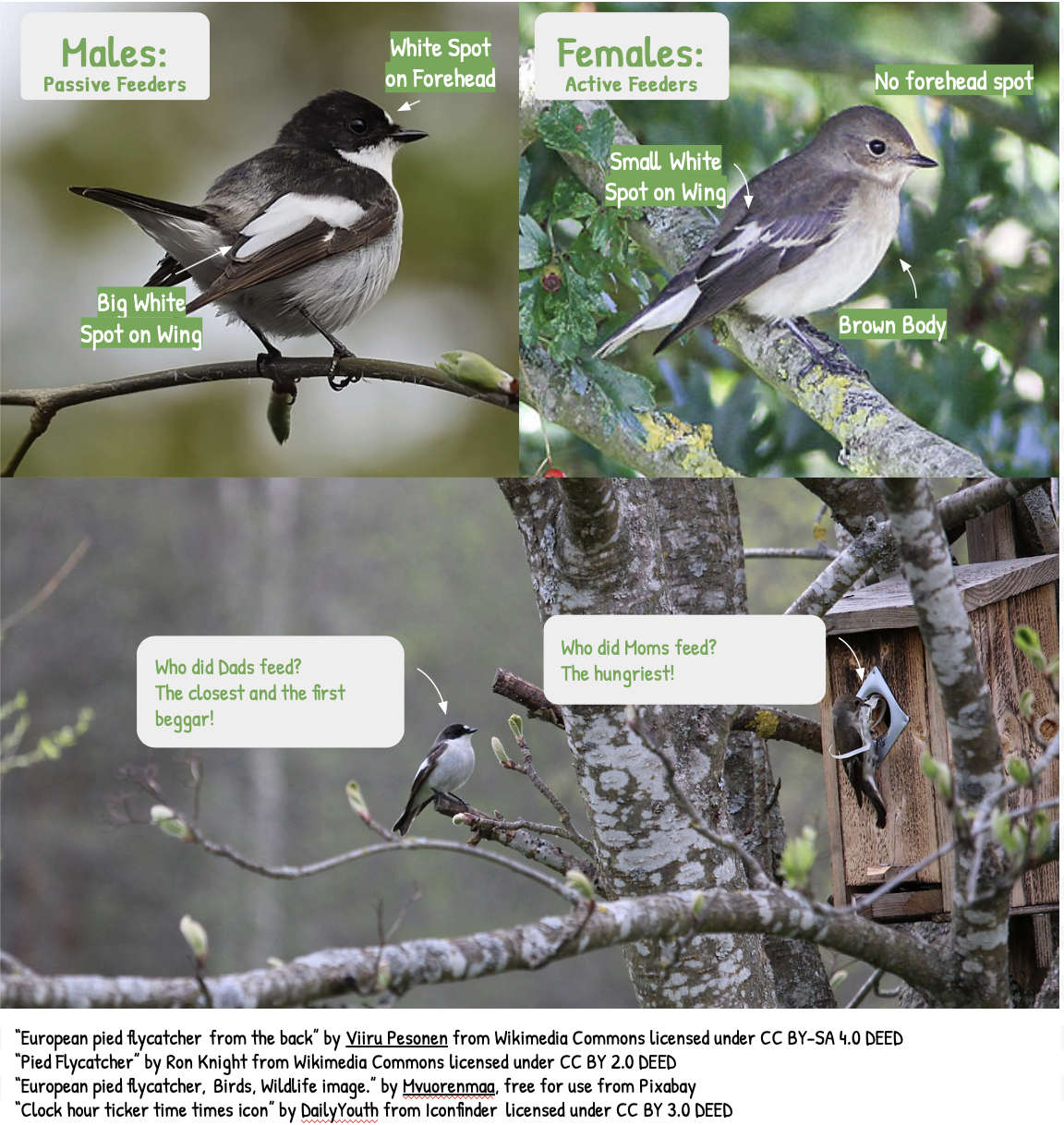
The researchers found that male flycatchers fed chicks based on where they were in the nest and when they begged. So, dads were most likely to feed the chick closest to himself who begged first.
On the other hand, female flycatchers fed chicks based not only on when they begged and position in the nest, but also how intensely they begged, whether the chick had been given Vitamin E, and whether the chick responded to prey testing. Prey testing is when a parent holds food over the chick’s mouth without dropping the food. Parents do this to evaluate the hunger of a chick. Dads prey-tested too, but it didn’t affect which chick they fed.
These patterns of behavior suggest that male flycatchers are more passive feeders while female flycatchers are more active feeders.
Why might this be?
It might seem strange that moms and dads of the same species feed their chicks in nearly opposite ways. However, it makes more sense when you consider that the birds are acting in a way that will help them have as many surviving chicks as possible. Feeding your chicks carefully, like the moms did, is one way to achieve this goal. However, trying to have more chicks is another way to achieve the same goal.
Male flycatchers might be less careful when deciding which chick to feed because they are busy finding new mates and trying to have more chicks. The males in this experiment did indeed make fewer and shorter visits to the chicks than the females. Female pied flycatchers can only lay eggs once per year. So, because they physically cannot have any more chicks, they have no reason to search for another mate.
The answer to the researchers’ question of how pied flycatchers decide which chick to feed ended up depending on the sex of the parent. How do you think other animals feed their young? What other factors do you think might change how parents feed their kids? To find out, you might just have to become a scientist!
Reference:
Parejo-Pulido, D., Pérez-Rodríguez, L., Abril-Colón, I., Potti, J., & Redondo, T. (2023). Passive and active parental food allocation in a songbird. Behavioral Ecology, 34(5), 729–740. https://doi.org/10.1093/beheco/arad043
