
As night falls on Earth, and the crickets start singing melodies while the moon rises above the horizon, many animals alike prepare to sleep. This is especially the case for humans. After a long day of school, work, playing with friends, and exercising, we need a mental and physical break from the daily activities that require us to use energy. Sleeping provides that break and is crucial to recover and stay well. Most of the time, for humans, we shower, put on pajamas, and crawl into a warm bed with layers of blankets and bulbous pillows. We do this because having a safe, dry, and warm environment is not only comfortable — but important in staying healthy and happy.
It isn’t just Homo sapiens who have a nightly routine and want to sleep in a safe and snug environment. A recent study found that chimpanzees have an elaborate method when it comes to finding a place to sleep.
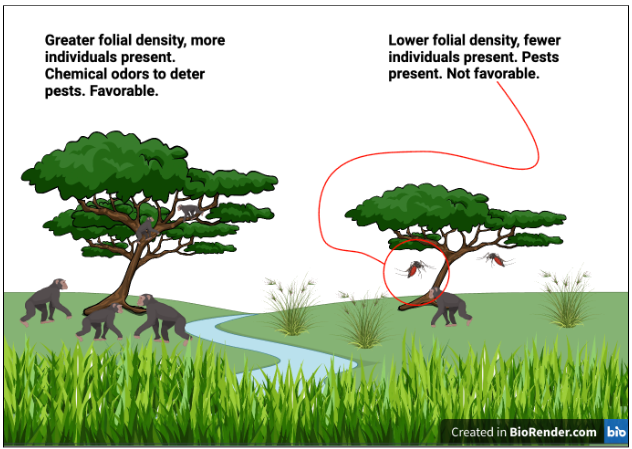
A group of scientists examined a family of chimpanzees in Kibale National Park in Uganda, Africa. Upon observing, the scientists realized that some apes choose a particular tree to build their nests solely on size, shape, rigidity, and the ability of the tree to deter predators and pests. They also judge the tree for its foliage density. Foliage density is simply the amount of leaves a tree has. Chimpanzees will make changes to the tree; such as removing tree limbs, detaching leaves, and placing them into a pile to increase the comfort of their nest to sleep well. Why do they do this?
Well, sleeping isn’t easy for all animals, and for chimps, they have to worry about possible attacks from predators, severe weather, and uncomfortable sleep settings. Finding a tree that can accommodate their needs is extremely difficult, but crucial.
You might ask yourself: “How can trees deter predators?” Well, the answer is rather simple. Just like when you’re sitting outside in the summertime, you may light a citronella candle to ward off pesky mosquitoes. Trees can have the same properties releasing chemicals that deter threats toward the chimps. By doing this, the chimpanzees are more likely to pick trees with this unique feature so they can sleep peacefully.
The scientists also explain the protective possibilities that trees may serve beyond chemical defenses. Think about running around the playground at school. You will be more likely to climb on the monkey bars and play on the equipment that you can reach. Otherwise, you’ll spend time and energy trying to do something nearly impossible! If you can’t reach something, or you may hurt yourself in the process, why do it?
The same goes for predators trying to hurt the apes. Chimps have an incredible evolutionary ability to climb which serves as a vital tool to escape threats by climbing high into the tree canopy. This is a direct reason why the results in the study showed chimpanzees prefer larger trees so their predators have a harder time attacking them. Smart, right? By ranking trees in comfort and protection level, the chimps’ unique ability to do this pays off by avoid harmful situations.
When researching animals, it is important to realize that we should not always compare animals to humans. This is anthropomorphizing. Animals, chimpanzees specifically, have their own ways of thinking that allow them to make decisions based on the environment they are in. In addition, we as humans should think about how our impacts are hurting populations of these beloved species.
According to The World Wildlife Fund, the distribution of apes in Africa is declining due to forests being cut down, cities growing larger, and the threat of poaching. Now that we know chimpanzees and other apes pick trees based on their comfort level, it is important to protect these trees from being destroyed so the chimpanzees can have a safe place to sleep and hide from predators. Because of this, many organizations have set up protected areas to ensure the safety of chimpanzees.
Chimpanzees are definitely strategic in picking their trees which pays off when they can evade predators and successfully survive. Next time you see a tree, think about the possibilities that tree has for many different species. How can it be helpful? Doing this will make you feel closer to the Earth and wanting to protect them for critters.
References:
Lacroux, C., Krief, S., Douady, S. et al. Chimpanzees select comfortable nesting tree species. Sci Rep 13, 16943 (2023). https://doi.org/10.1038/s41598-023-44192-6
