

By Bella Stevens ’22
Shark numbers are rapidly declining, mainly due to commercial fishing and bycatch (1). But why should you care? The word “shark” probably doesn’t generate warm, fuzzy feelings. Sharks, particularly Great Whites, get a bad rap, thanks to representation in the media. However, sharks are crucial in maintaining ocean health. As apex predators, they control prey populations and cause shifts in their prey’s geographical habitat. A decline in shark populations affects ocean ecosystems and even our economy. For instance, a study in North Carolina showed that a decline in Great White Sharks led to an increase in ray population. These rays fed on bay scallops, forcing the scallop fishery to close (2). In conservation efforts, it isn’t hard for the general public to get behind saving the cute mammals like pandas or orangutans. While such efforts should be rewarded and continued, it’s easy to forget how important certain animals are to our future when those animals aren’t particularly the cuddliest.
Imagine if someone came at you with artificial sound and strobe lights just to see how you’d react…you probably wouldn’t like that. It may sound mean to try that on sharks, but it’s important in finding ways to keep sharks away from people and fisheries. Laura A. Ryan and Lucille Chapuis conducted an experiment in 2017 that explored the effect of auditory and visual stimuli on shark feeding behavior, also called the “disco effect”. If strobe lights and loud, artificial sounds can deter sharks from bait, maybe they can deter sharks from people and fisheries? Currently, we typically deter sharks by overstimulating their electrosensory and chemosensory systems, like the use of strong magnets on fishing gear to reduce bycatch. However, there is evidence that sharks can habituate to the electronic pulse. Some areas use culling and beach netting, which is not only harmful to sharks but to other non-target animals. Luckily, Cartilaginous fishes, like sharks and rays, have a wide range of sensory systems from electroreception to olfaction. There is also variation in photoreception and auditory abilities between different shark species. So there are multiple sensory systems that we could manipulate to possibly deter sharks. Research that seeks to understand these different systems is key to creating the most effective mitigation device.
This experiment looked at three shark species: Port Jackson and Epaulette Sharks living in captivity, and Great White Sharks in the field. They measured the effects of intense strobe lights (waterproofed LEDs), loud, artificial sound with mixed frequencies and intensities (underwater speaker), and combinations of both on whether bait was taken and how long it took for the bait to be taken. For the captive sharks, an experiment was conducted in an aquarium where an individual was tested for each treatment six times. The light was positioned in front of the speaker, with the bait in front of the strobe light (this is illustrated in the figure). Artificial sound did not have a significant effect on the behavior of either Port Jackson or Epaulette, unless it was combined with the strobe light. On the other hand, the strobe light greatly affected the behavior of Port Jackson. They observed many times that whenever the strobe light was turned on, the shark stopped swimming and would only start when the light was turned off. Guess they aren’t fans of disco. The strobe lights dissuaded Epaulette but not to the degree that it did with Port Jackson. This is probably because visual systems often differ between shark species. Port Jackson are known to likely only have rods in their retina (see figure), which in photoreception are responsible for perceiving low light. Basically, this makes them more sensitive to bright, flashing lights than species like Epaulette which also have cones that function better in bright light.
These differences between species are part of the challenge in creating effective mitigation devices. There is so much variation! A method might put off one species, but attract another. We see this play out with the Great Whites, who didn’t seem bothered by the sudden underwater disco. In Mount Bay,
South Africa, a strobe light was mounted above a bait canister, and the underwater speaker was put in between cameras which pointed towards the bait. The stereo camera rig was dropped from the boat 2 to 4 times a day for five days and the video captured was analyzed to determine how long an individual stayed in the frame and if they took the bait. There was little difference in behavior between treatments, and in how much time a shark spent in the camera’s field of vision, and the bait was bitten in all treatments. The only possible deterrence observed was that in the strobe light plus sound trials, the individuals’ interactions with the bait were delayed. Why was there little effect on the Great White’s feeding behavior? This likely goes back to the variance in sensory systems of different species, but it could also involve trophic levels, i.e. the food chain. Great White Sharks are one of the top dogs in the ocean, and have few natural predators. They’ve even been described as inquisitive and curious animals. Why? Probably because Great Whites can afford to be curious! Unlike Port Jackson and Epaulette, Great White Sharks have a lower risk of predation and so have less “reason” to be cautious. Although the Great Whites weren’t particularly turned off by the underwater disco, the possible deterrence from combining both stimuli gives us a hint that having two stimuli can be effective in deterring sharks. Like all animals, sharks utilize multiple senses, and a combination of different stimuli may amplify avoidance behavior by increasing the likelihood of detection.
There is more research to be done to further understand the different sensory systems of sharks. But this research showed the potential that strobe lights have for deterrence of certain species. Because there is so much variation, species-specific bycatch mitigation devices may be more effective than attempting to deter multiple shark species from human interactions and fishing boats. The more research that is done, and the more awareness is spread, the better chance sharks and our oceans have of a future.
Ryan L., Chapuis L., 2017. Effects of Auditory and Visual Stimuli on Shark Feeding Behavior: the Disco Effect. Marine Biology (2018) 165:11.
1) Cox, Lisa. “Shark Numbers Decline by up to 90% in Five Decades off Queensland Coast.” The Guardian, Guardian News and Media, 13 Dec. 2018, https://www.theguardian.com/environment/2018/dec/14/queensland-shark-numbers-down-by-90-per-cent-in-55-yea rs-for-some-species.
2) “The Importance of Sharks.” Oceana EU, https://eu.oceana.org/en/importance-sharks-0.
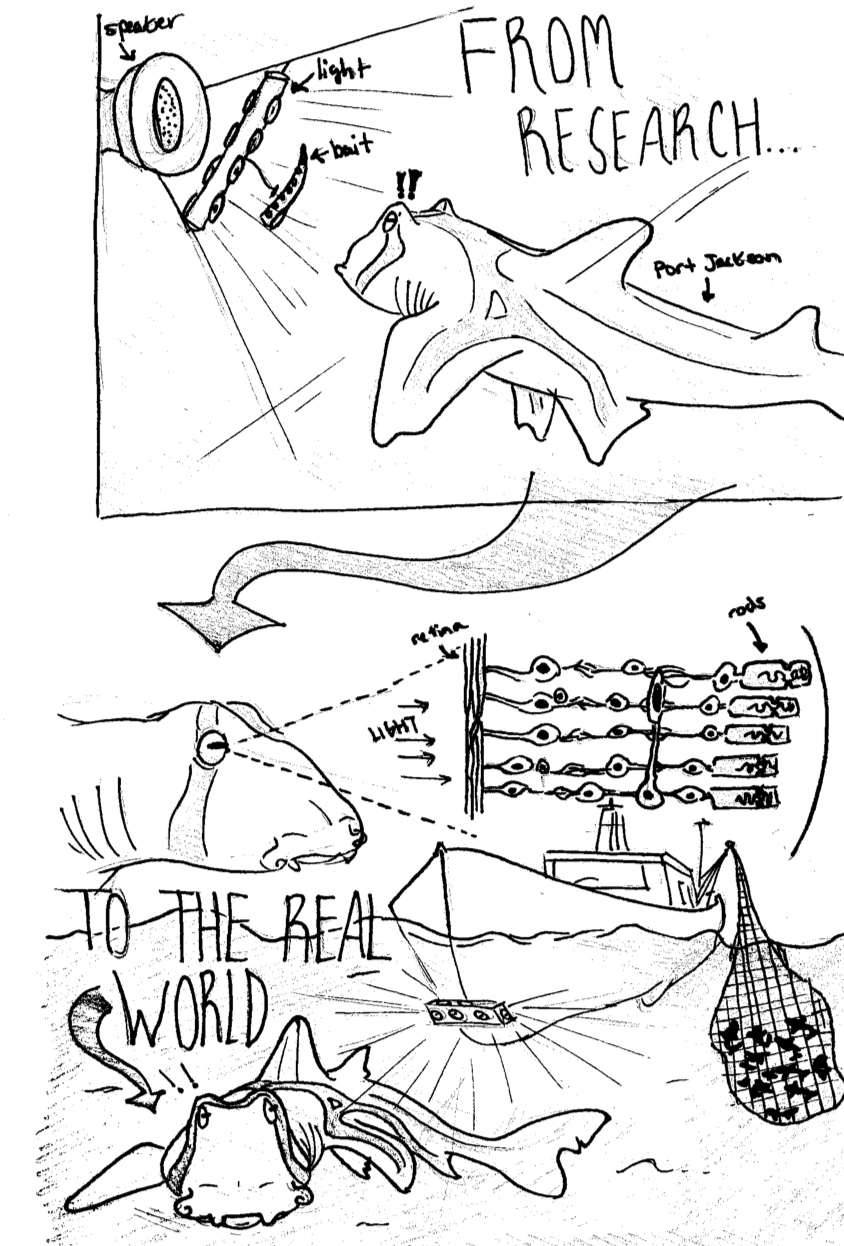
The results found in Ryan et al. (2017), specifically for Port Jackson, can be used to create a mitigation device that deters Port Jackson and possibly other shark species that are deterred by strobe lights, due to factors such as the lack of cone photoreceptors as discussed in the article.
