
By Meg Dye ’22
For almost as long as humans have been studying animal behavior, scientists have been fascinated not only with how different animals perceive and react to various stimuli, but specifically with how certain animals perceive and react to other individuals. In other words, which specific signals about other individuals trigger their perception and affect their behavior?
The identification of the face as a “special stimulus” established through the observed tendency of humans, nonhuman primates, and other social mammals perceiving faces differently from other stimuli, or even differently from other other parts of the body, has been well-documented. However, little is known about face-viewing patterns in non-primate animals, specifically in non-mammalian vertebrates. Takashi Hotta and other researchers from Osaka City University and Kyoto University in Japan set out to contribute to this body of knowledge by studying the face-viewing behaviors of the African cichlid fish Neolamprologous brichardi.
N. brichardi are a species of fish that live in stable social groups with established individual roles and dominant pairs. Sporting black horizontal stripes behind their eyes
that signal dominance and fighting ability, they are able to discriminate between fish of the same and different species based on facial coloration alone within half a second. Based on this, Hotta et. al hypothesized that African cichlid fish would demonstrate similar face-viewing patterns to those seen in previous mammal studies. In order to most accurately detect visual targets of the African cichlid fish, Hotta et. al established a method of determining visual focus based on the forward direction of the vertical axis of their bodies. This provided a convenient alternative to eye-tracking methods used when studying visual recognition in primates while still offering a degree of methodological similarity.
The research group separated their study into two experiments. The first experiment was conducted in order to establish N. brichardi’s ability to detect a small target. They did this by directing a red laser point at a blank white background and recording varying distance between the stopping point of the fish and the red dot as well as lateral deviation distances determining whether the dot was in the fish’s left or right field of vision. The significant correlation between lateral deviations as recorded by two different raters conducting the experiments as well as the lack of correlation between target distance and lateral deviation both indicated that the extended body axis direction of N. brichardi provided accurate estimations for where the fish were visually focused. Since African cichlid fish demonstrated their ability to orient themselves toward a small target, the use of body axis directionality to estimate viewing point as an accurate attention-tracking method was confirmed and Experiment 2 was subsequently conducted.
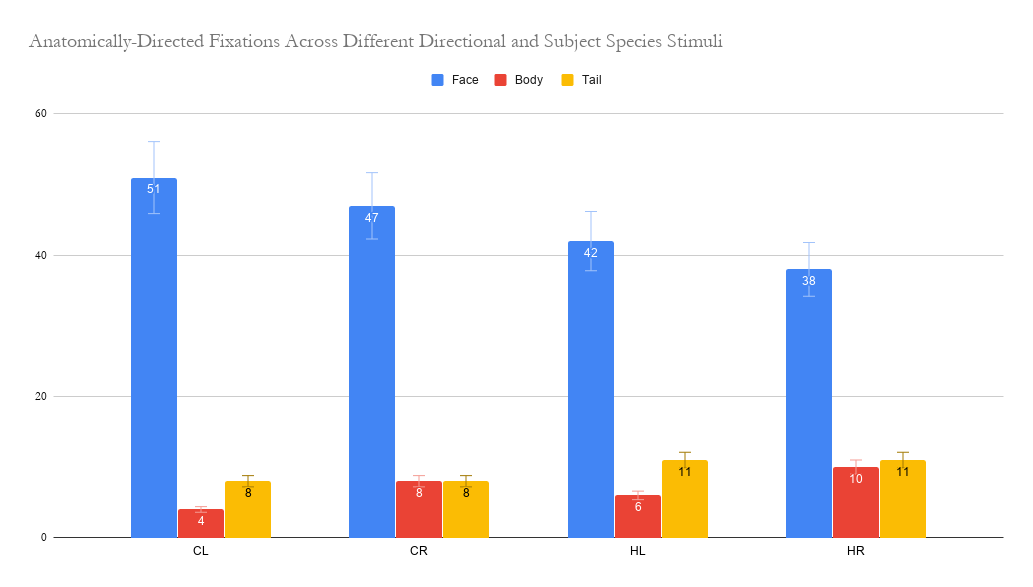
The second experiment tested whether N. brichardi would pay attention to the face over other anatomical features by presenting N. brichardi with photographs of other N. brichardi (conspecific treatment group, being a stimulus of same-species fish) as well as Lake Tanganyika cichlid, Julidochromis transcriptus, which present different color patterns and shapes than African cichlid fish (heterospecific treatment group, being a stimulus of a different species of fish). An ellipse pattern was also presented to act as a control stimulus for comparison. Researchers found that subjects oriented themselves in the direction of the face significantly more often (Figure 1) and for longer durations of time than at any other part of the body or tail regions in both conspecific and heterospecific examples. Side of model (right or left) did not significantly affect viewing pattern and, unlike results seen in prior mammalian studies, there was no significant difference between conspecific and heterospecific detection.
These results ultimately suggest that N. brichardi pay more attention to the face than to any other area of the body, similar to primate subjects tested in prior studies. These results also confirm that facial stimuli are presented in the binocular visual field and that subjects gather facial information with both eyes, as no significant preference for either the right or left eye was shown.
Hotta, Takashi, et al. “Fish Focus Primarily on the Faces of Other Fish.” Scientific Reports, vol. 9, no. 1, 10 June 2019, doi:10.1038/s41598-019-44715-0.
