

To most humans across the world, or at least in the minds of those who have watched the Jaws franchise, sharks are bloodthirsty beasts out for human flesh. However, sharks have much in common with humans, especially when it comes to finding the perfect partner. Let’s just say awkward and seemingly pointless displays of courting behavior, like dates, are not unique to humans since basking sharks seem to have their own version of speed dating.
Off the coast of Western Ireland and Scotland in the Eastern North Atlantic Ocean, scientists observed basking sharks swimming in a circular rotation as if they were playing follow the leader, a rather unusual phenomenon. Typically, basking sharks are solitary creatures, so why exactly are these sharks taking time away from hunting and other valuable behaviors to swim together in funny circles? David W. Sims and a host of other scientists set out to answer this question through detailed aerial and underwater video recordings and direct observation from boats and scuba divers.
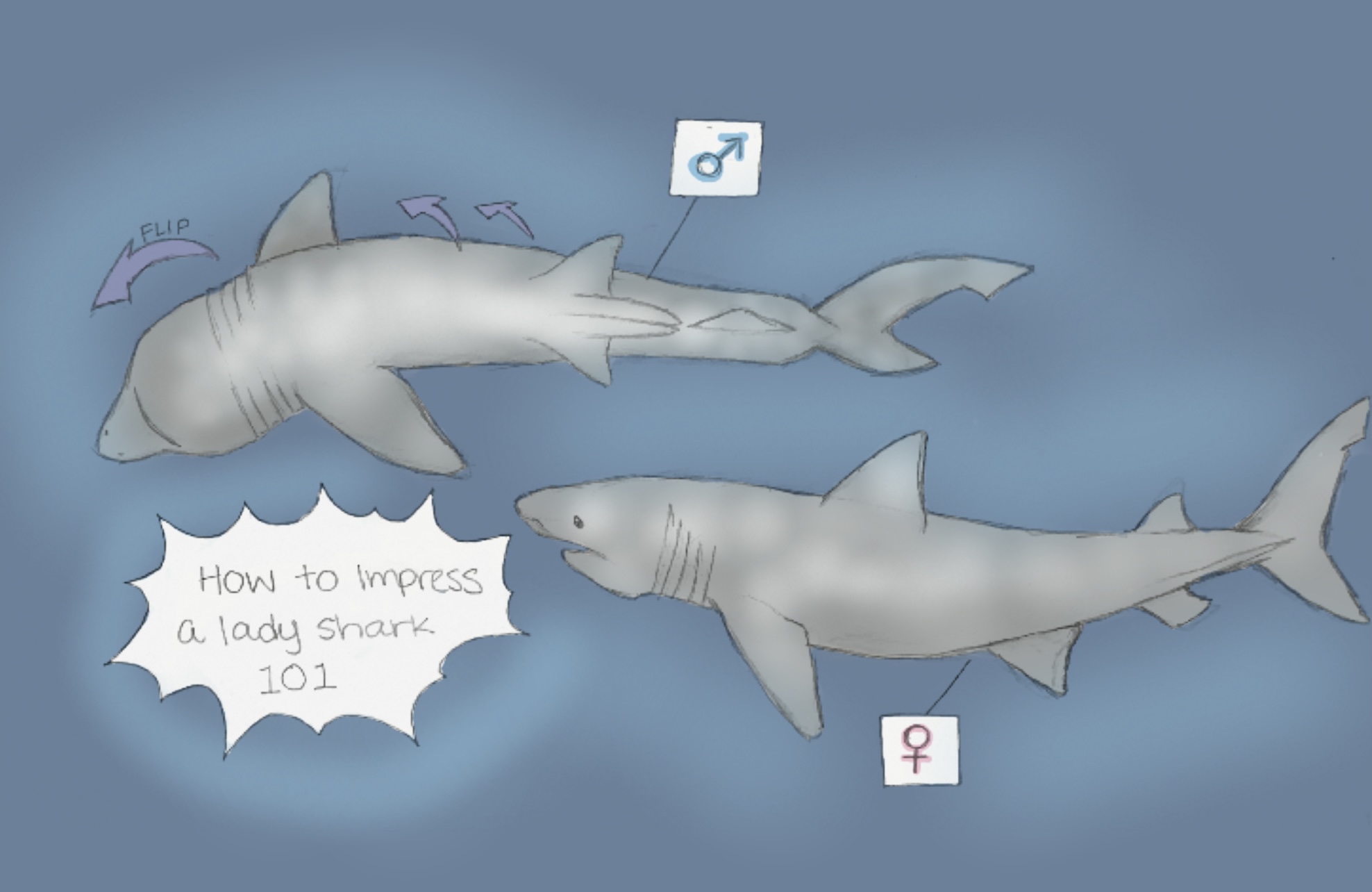
The scientists first noticed that plankton was abundant in the water surrounding the basking sharks, their typical food source. However, none of the basking sharks were observed to be feeding off the plankton and instead continued to swim in circles. These circular formations became known as toruses, a geometric shape generated by a circle rotating about an axis in its plane without overlap – or a 3D donut if you wish. Not only were they swimming in these toruses, but they were also swimming in a parallel and echelon (diagonal) fashion relative to each other and continuously switching positions after completing a half-torus rotation. To follow the analogy, this signal is akin to a bell ringing at a speed dating event, letting everyone know it is time to change partners. Switching happens multiple times as toruses consist of six to twenty-three sharks and go on for between two to five hours, so each shark has a chance to meet all the other sharks in the group and put on a bit of a display. This display comes in many forms. Whether that be a full body breach out of the water, a nodding behavior in which the entire dorsal body is flexed and the caudal fin is lifted up and down, or a nice spin and dive to show off everything it has to offer to potential partners.
Another interesting aspect is that within the toruses, there was a relatively even ratio of sexually mature males to females. This observation was indicated by the coloration, as the males had slightly darker coloration than the females. But how do we know that all the sharks are sexually mature? Male sharks also have what are known as claspers, which are two long external organs located on the pelvic fins. During mating, a male shark will bite a female’s fins and other body parts to align their underbellies before inserting a clasper into the female’s cloaca. The cloaca is an opening that connects to the female’s oviducts. The length of a male’s claspers is a good indicator of whether or not the shark is sexually mature; the male sharks observed within the toruses had long claspers, indicating that they were indeed at an age of sexual maturity. In addition, most of the males seen had claspers with abrasions or bruises, and the female sharks appeared to have bite marks and tears near their fins, indicating that recent mating activity had occurred. All the sharks observed in the torus formation exhibited these traits, leading scientists to conclude that this was likely a courting ritual before or during mating.
Basking shark dating may not seem so crucial at first, yet it provides us with an insight into how the vulnerability of overfishing is a driving force for the decrease in the shark population. Sharks have prolonged growth rates and reach sexual maturity later in life. Male basking sharks generally reach sexual maturity at around 4.6 to 6.1 meters or approximately eight years old. Females reach sexual maturity at 9.1 to 9.8 meters or close to twelve years old. They also have a general gestation period of three years (Powell). Many preferred basking shark habitats tend to overlap with industrial fisheries. Basking sharks are essentially killed before they are mature enough to engage in the toruses and mate. Therefore, the areas where toruses frequently occur must be protected to ensure that basking sharks live long enough to engage in this courting behavior and go on to reproduce, in turn making it so they are less likely to go extinct in the near future.
References:
Powell, L. (n.d.). Cetorhinus maximus basking shark. Animal Diversity Web. https://animaldiversity.org/accounts/Cetorhinus_maximus/#:~:text=At%20birth%2C%20basking%20shark%20pups,or%20after%20about%2011.5%20years
Sims, D. W., Berrow, S. D., O’Sullivan, K. M., Pfeiffer, N. J., Collins, R., Smith, K. L., Pfeiffer, B. M., Connery, P., Wasik, S., Flounders, L., Queiroz, N., Humphries, N. E., Womersley, F. C., & Southall, E. J. (2022). Circles in the sea: annual courtship “torus” behaviour of basking sharks Cetorhinus maximus identified in the eastern North Atlantic Ocean. Journal of Fish Biology, 101(5), 1160–1181. https://doi.org/10.1111/jfb.15187
