

Everyone knows that the city never sleeps, but what do some of its smaller residents do when it’s time for lights out? A new study [1] published by the Royal Society studied the birds Great Tits, scientifically known as Parus major, and found that they are indeed affected by nighttime lights. Artificial light at night, or ALAN, is so widespread that we hardly even notice it. We use it daily (and nightly) to navigate our world, after all. Streetlights, headlights, illuminated signs, and light from our windows are all common examples. Cities are particularly prominent offenders: if you look at Nasa’s satellite images [2] of the Earth at night, you can see every major metropolitan area highlighted by our shining electrical footprint. While we depend on this light for our survival, it often hinders that of other species. McGlade et al, published just this month, studied the impacts of ALAN on Great Tits, both in cities and in the forest. With the guidance of their findings, we’ll take on a bird’s eye view of the situation to try to understand how our lights affect these little birds.
Artificial light exposure has been shown to disrupt melatonin levels in Great Tits. Previous studies have documented disrupted sleep patterns in birds in and near cities, but it was unclear whether the underlying cause was in fact ALAN, or some other factor associated with development, such as noise or temperature. Our researchers sought to isolate the cause. To discriminate between what city birds experience, what birds in a natural environment experience, and the effects of ALAN, researchers created three study groups of Great Tits. All groups were composed of females incubating (sitting on) clutches of eggs in nest boxes in Scotland. There was an urban group, composed of birds living in the city of Glasgow. There were also two forest groups: one, the control or “natural” group. The other was the ALAN group. These birds had a small LED light installed in the top of their nest box, turned on 24/7. Because they continued to live in the forest, this treatment served to isolate the effects of ALAN on the birds from any effects of other variables associated with city life.
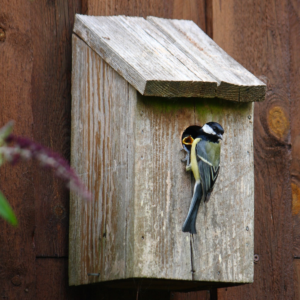
This image is licensed under CC 1.0 Public Domain
These three groups were studied throughout the incubation period (about 15 days). Researchers used temperature sensors to determine the amount of time that the female spent on and off the nest, along with subsequent changes in clutch temperature. The three factors examined were the mothers’ onset and offset of activity times (time that they woke up and went to sleep), along with nighttime restlessness (measured via clutch temperature changes overnight). Researchers found that, on average, females woke up in the morning between about four fifteen and six forty five in the morning, and went to bed (for lack of a better term) between four forty five and ten PM. In between these times, females usually alternate between foraging and incubating. While dad does help feed her, mom is on her own a lot of the time when it comes to dinner!
We begin to see some differences between nests when we compare study groups. Urban birds, on average, woke up about 16 minutes earlier than natural controls, and forest ALAN birds woke up about 14 minutes earlier than natural counterparts. Additionally, forest control females went to sleep earlier as incubation progressed, but urban and ALAN females retained the same “bedtime” throughout the incubation period. Thus, natural-lighting birds spent more time resting as their eggs got closer to hatching, but the birds exposed to artificial light missed out on those extra Z’s.
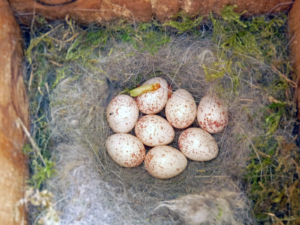
“Great Tit Nest” by Fæ is licensed under CC BY-SA 2.0
Furthermore, nighttime restlessness was higher in forest ALAN birds compared to other groups. These females exhibited similar early rising times and late bedtimes to the urban birds, but were more restless at night than either forest controls or urban females. We don’t know why we only saw this change in ALAN birds and not urban birds. One explanation is that less light reaches into the inside of nest boxes in the city when compared to the artificial lightbulb, which gave the forest ALAN birds constant nighttime light. Another potential explanation is that the forest ALAN birds, who had previously lived without artificial light, simply had a hard time adjusting to sleeping with a nightlight. Urban birds, who’ve presumably lived in these illuminated conditions their whole lives, may simply be more used to sleeping through it. Overall, we can see that exposure to artificial light means that these hard-working moms get less sleep than they would living off the grid.
To recap, both urban and forest birds exposed to ALAN got less sleep, but forest ALAN birds who “slept with the lights on” experienced more restlessness. Why does this matter? Well, Great Tits are cavity nesters, so they build nests in closed spaces like the nest boxes. Because city lights probably don’t reach into these spaces very well, they might be protected from some of the effects of 24/7 light exposure that we saw in the forest ALAN birds. This is good for our city slickers! The downside is that this protection won’t apply to birds that build more exposed, “open” nests, like robins, goldfinches, and cardinals, to name a few. If birds with open nests are more exposed to artificial light, it may mean that they are more restless, like we saw in the forest ALAN birds. Recall that restlessness was measured in overnight temperature changes in clutches of eggs. This is concerning because this variability may affect offspring after hatching. More work would need to be done to see for sure, but potential effects may be seen in chicks’ growth rate, metabolism, or cold tolerance.
Now, this is upsetting, but the impacts of this study may still seem narrow. Its real significance is that it is an important piece contributing to a much larger picture: we as humans have huge impacts on many creatures, often in ways that we seldom consider until it’s too late. As we begin to understand the ways in which we affect our environment, we should take action to minimize our proverbial footprint. You, as a reader, can start small. Turning off your lights at night may seem silly, but it could make all the difference for one (or more!) very tired moms.
References
McGlade, C. L., Capilla-Lasheras, P., Womack, R. J., Helm, B., & Dominoni, D. M. (2023). Experimental light at night explains differences in activity onset between urban and forest great tits. Biology Letters, 19(9). https://doi.org/10.1098/rsbl.2023.0194
Carlowicz, M., & Przyborski, P. (2012, December 5). Out of the Blue and Into the Black. NASA Earth Observatory. https://earthobservatory.nasa.gov/features/IntotheBlack

