

Often, infants and young children misbehave, don’t follow rules, and generally make one question how much energy goes into raising them. However, for humans it is often the joys of raising a child that encourages reproduction. Reproduction is a very energy depleting process, and for other mammals is invested for the success of oneself and one’s species as a whole. Reproduction becomes especially difficult when in a resource deprived state, such as a lack of food or nesting sites, as is the case for Hoopoe birds. What if there isn’t enough food to go around? Who gets fed first? This is where the parent’s evaluation of need hierarchy as well as quality of begging comes into play. At least this is what was thought, but for hoopoes, there appears to be a different story.
Food allocation of Hoopoes in the presence of excess food, as well as a normal control environment, was studied by Ferrer-Pereira et al. in their article titled “Food Supply and Provisioning Behavior of Parents: Are Small Hoopoe Nestlings Condemned to Die?” The experiment they conducted included 47 total nests, 43 of which contained nestlings of each size category (small, medium, and large). Of these 43, 21 nests were experimental and 22 served as control nests which did not receive additional food. The 23 experimental nests were given an additional 20-25 crickets each morning for two consecutive days (after the final nestling hatched), which consisted of a filled falcon tube of 15 mL crickets. The experimental crickets lasted only 1-2 hours in the nest as the females instantly detected their presence. Feeding behavior was documented through video recordings and then analyzed for a variety of measurements. The two most important measurements to this study were begging rates, which is “percentage of feeding events in which nestlings of each size category begged for food” and begging success, which is defined as the “rate in which begging nestlings of each size category were fed by their mother” (Ferrer-Pereira et al., 4).
When evaluating the recordings, it was found that female preference and begging success of each size was not dependent on the day or the day period. Additionally, with each feeding event, whether there was extra food, the size of the nestling receiving the food and the social context, meaning the size category of nestlings begging for food, were all recorded in order to evaluate female preference. Begging success, determined as percent food given to each size category of the 43 total nests, resulted in 61.11% large, 21.10% medium, 11.31% females themselves, and 6.49% small. Conversely, begging rate in the presence of food turned out to be 73.00% small, 71.74% medium, and 78.67% large. Even in the presence of extra food. Large nestlings were fed preferentially. It was only with large nestling satiation, essentially being overly full, that medium nestlings received food. Additionally, females only ate when small nestlings were the sole beggars. Thus, if you are a small nestling, you stand close to no chance of receiving food, regardless of how much you beg. However, begging by all sizes was acknowledged more if food supply was high.
In conclusion, female hoopoes preferentially feed their large nestlings. This may be confusing from an anthropomorphic view, but is beneficial for the bird’s fitness, as the female’s energy goes to offspring that will be more likely to survive and reproduce if the large nestlings are fed. It is important to note that this experiment was conducted during the period when Hoopoe females rarely, if ever, leave their nests (throughout the hatching period of nestlings). Thus, food is provided by the male and then portioned out by the female to both offspring and herself. It would be interesting to evaluate this in comparison to when the females are both catching and supplying the prey to their offspring. Would preferential feeding of large nestlings prevail?
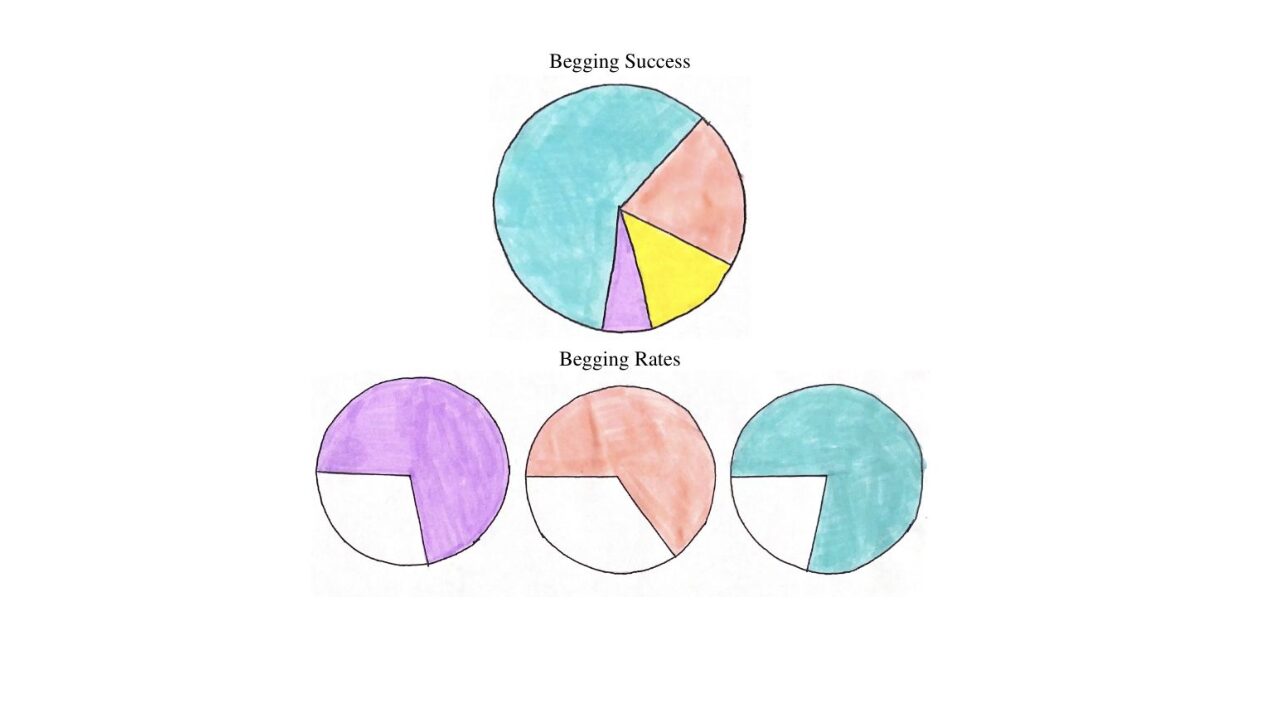
Begging Success verse Begging Rates in Hoopoe Nestlings” by Justine Cole is licensed under CC by 4.0.
Citations
Ferrer-Pereira, Paula, Martínez-Renau, Ester, Martín-Vivaldi, Manuel, Soler, Juan J. “Food Supply and Provisioning Behavior of Parents: Are Small Hoopoe Nestlings Condemned to Die?” September 4, 2023. Oxford Academic. https://doi.org/10.1093/beheco/arad067
