
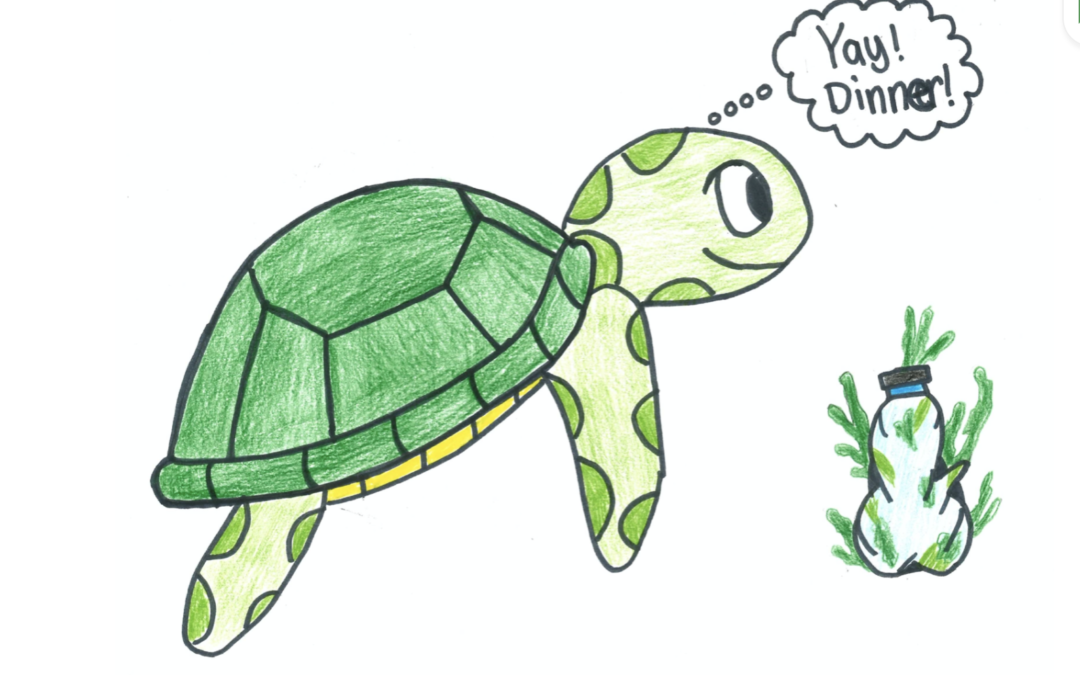
Imagine you are a giant sea turtle swimming through the deep, blue ocean. You discover what you think is food and immediately eat it believing it’s your favorite snack, a tasty jellyfish. Unfortunately, the food you ate was not a jellyfish and was actually plastic.
Sea turtles mistaking plastic for jellyfish has been a hot topic of conversation in marine biology for years. While sea turtles do in fact mistake plastic for jellyfish, they also eat plastic materials that do not resemble jellyfish, which is puzzling to scientists. Because of the different types of plastic that are consumed, scientists are curious about what attracts sea turtles to plastic if it is not simply the appearance.
To determine if scent plays a role in sea turtles’ attraction to plastic, researchers exposed 15 loggerhead sea turtles to one of four scents: water, turtle food pellets, plastic that has never been in the ocean, or plastic that has been in the ocean and contains microorganisms. The water and turtle food pellets served as the control to make sure outside factors were not influencing the behavior of the turtle. They measured the amount of time the turtle spent with their nostrils above water and how many times the turtle came up for a breath of air. The more time the turtle spent above water, the more attracted it was to the scent.
After testing each of the 15 turtles with a different scent, the researchers found the turtles exposed their nostrils three times longer when the scent was either plastic that has been in the ocean for a long time or food pellets compared to when the scent was clean plastic or water. This suggests that the sea turtles behave differently and are attracted to the scent of the plastic that had been in the water for a while because it smelled like the foods they enjoy. This is particularly important because sea turtles use scent to find their prey, and plastic is interrupting those signals. The turtles think they are getting a nice, nutritious meal, when they are actually eating toxic and harmful chemicals.
Plastic needs to stay out of the ocean. Recycling plastic instead of throwing it away and using plastic made from recycled materials are the best ways to help protect the sea turtles. Sea turtles lived on this planet long before we did and it is our duty to protect them and the ocean.
Pfaller JB, KM Goforth, MA Gil, MS Savoca, KJ Lohmann. 2020. Odors from marine plastic debris elicit foraging behavior in sea turtles. Current Biology. 30:213-214
https://www.sciencedirect.com/science/article/pii/S0960982220301159?via%3Dihub
