
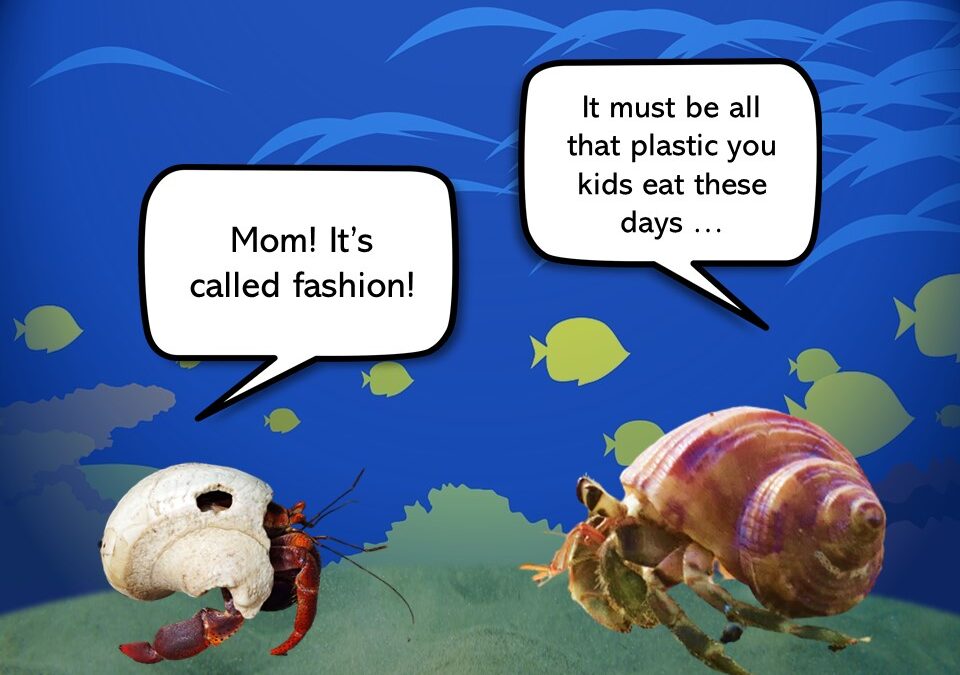
A hermit crab is a type of crab that has a soft belly, which makes it vulnerable to all the animals that want to eat it (bigger crabs, fish, and seagulls love to eat hermit crabs). So to try and protect themselves, hermit crabs look for empty sea shells, which are usually left over from sea snails. They enter the shells and use them as armor and a hiding spot. It’s important that they choose the shells carefully; they have to be just the right weight to ensure good shelter, but not too heavy – the crabs have to carry them on their backs the whole time! So just like you get new shoes as your feet grow, hermit crabs change their shells as they get bigger. They will also ditch their old shell if they stumble upon a newer and better one. Selecting a perfect and safe shell is very important to hermit crabs, and it seems like ocean pollution is making it harder for them to choose well.
If you think about it, us humans use A LOT of plastic, and we’re not doing a great job when it comes to preventing plastic waste from getting in the environment. When plastic breaks down to really small particles, it’s called microplastic. Because they are so small, microplastics can go unnoticed in food and water, and animals eat them without knowing. Scientists found out that consuming plastic this way can damage animals’ growth, movement, and even social life!
Andrew Crump and his team of scientists wanted to see if eating microplastics affects the way European hermit crabs (or Pagurus bernhardus – their name in Latin!) choose their best shell, so they took their crabs and divided them into two groups: one group lived in clean salt water, and the other was salt water polluted with microplastics. The crabs didn’t have shells, so the scientists first gave all of the crabs lousy shells that were too light to provide good protection. Then they put each crab in a container with a better new shell – this one was just the right weight. They wanted to see how long the crabs would take to switch their lame old shell for a great new one, and if they would want to switch it at all. Their results showed that crabs that spent time surrounded by microplastics switched shells less, and if they did, it took them longer than the ones that were in clean salt water. Much more of the plastic-surrounded crabs didn’t even bother to explore the new shell! That means they didn’t realize how bad their old shell was and how good the new one is, so they didn’t feel the need to change it. This is bad because if the crabs can’t choose the best shell, they are unsafe and are more likely to get eaten! Andrew and his team think that microplastics are affecting hermit crabs’ brains and preventing them from thinking clearly, but they’re not sure. We need to do more similar experiments to figure out why and how exactly microplastics harm hermit crabs.
References
Crump A, Mullens C, Bethell EJ, Cunningham EM, Arnott G. 2020. Microplastics disrupt hermit crab shell selection. Biol. Lett. 16: 20200030. http://dx.doi.org/10.1098/rsbl.2020.0030
