
Adam(Zhonglyu Liu)
Have you ever thought about the impact our human lives will have on the behavior of animals in cities? Some experts predict that by 2050, 68% of the world’s population will be living in cities. And so many people live in cities, their lives will have what impact on the animals? Think about the noise made by driving every day; the greenhouse effect caused by excessive carbon dioxide emissions that keep the temperature of the city from dropping. These results of human activity can cause animals to adapt in the city.
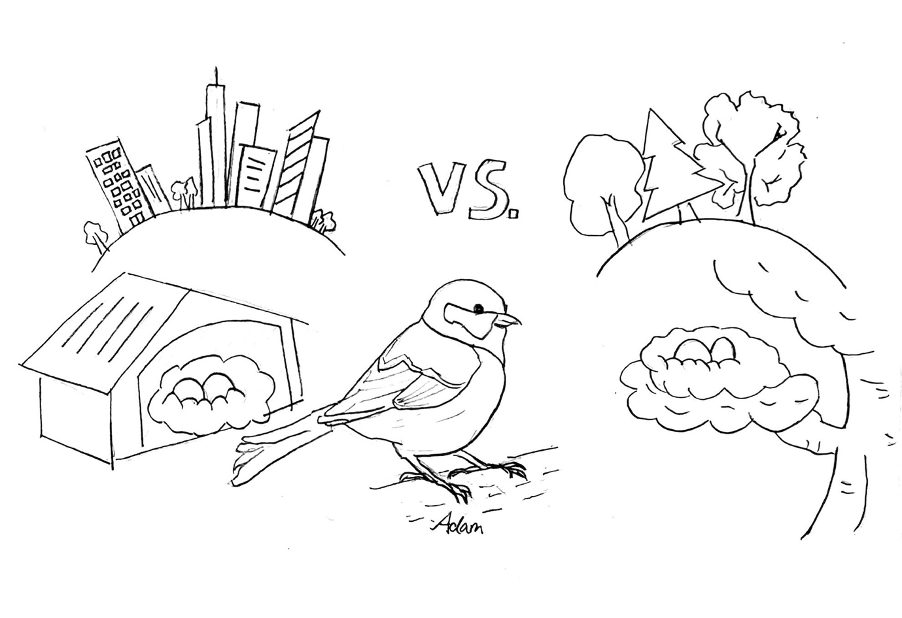
One of the most important aspects of bird parenting is incubation, but the effects of urbanization on incubation behavior have not been adequately studied. So here, we investigate whether urbanization affects bird incubation by measuring incubation behavior, duration of daily incubation activity, and egg temperature in an urban and a forest population of tits. Bird parents must keep their eggs within a small temperature range to ensure successful incubation. Although studies have shown that some factors associated with urbanization, such as higher ambient temperatures (i.e., the urban heat island effect), noise, nighttime light, and human activity, affect bird incubation behavior, comparisons of incubation behavior between urban and rural bird populations are lacking. So here I would like to present a recent experiment done by biologists. parenting in the city: effects of urbanization on incubation behavior and egg temperature in great tits, Parus major.
Scientists studied two populations of tits, one in an urban area (Niort, France) and the other in a nearby forest (French Forest). Niort is a small city in western France with an area of 68.20 km^2, an average altitude of 28 m, and 58,707 inhabitants. The forest is a deciduous forest in the commune of Villiers en Bois in western France, with an area of 34.35 km^2, at an altitude of 47 to 101 m, and 20 straight kilometers from the city.
The scientists predicted that urbanization would result in cooler and more variable egg temperatures in urban nests compared to forest nests. They also hypothesized that urbanization would affect the daily activity times of incubating females due to differences in light and noise.
Specifically, we predicted that, compared to forest females, urban females would begin their first daily off-bout at an earlier hour and end their last daily off-bout at a later hour.
In the scientists’ experiment, they collected data from a total of 10 forest nests and 14 urban nests, each with an incubation time of 7 days. And the final results compared to the three guesses above, we also got the answer with data support. First, contrary to the scientists’ predictions, urban females had less time to leave the nest and shorter time to leave the nest compared to forest female tits. This suggests that urban females may be less energetically constrained during incubation; for example, urban female tits are also likely to forage quickly because animal territories in urban areas tend to be smaller than those in forests.
Second, speculation about different egg temperatures in cities and forests resulted in nearly identical egg temperatures in nests from the two different areas. Although urban females took more time to incubate than forest females, and despite the fact that urban ambient temperatures tended to be warmer, urban eggs experienced relatively similar mean egg temperatures compared to forest eggs.
Third, as predicted, the results of the experiment showed that female fits in cities ended their daily activities later compared to forest females. This is because the light at night in urban areas may disrupt sleep or allow more time for tits to forage at night. It is also possible that urban females may be more active at dusk due to the generally lower risk of predation in urban areas when forest females would experience too much risk of predation.
Overall, our study suggests that urban habitats face different challenges than forest habitats, but the results of both sets of comparison experiments appear to be within the range of conditions that the species seems to be able to tolerate. Although urban females appear to invest more time and effort in incubation behavior than forest females, egg temperatures were similar across habitats, and there were no differences in any of the offspring characteristics we measured in relation to fitness. Thus, the behavioral differences we observed may represent different behavioral strategies tailored to specific habitats and ultimately lead to the same outcomes for offspring. However, some cues in urban areas, such as light at night, may trigger higher female activity at night when temperatures drop, even if it is detrimental to embryonic development. The conclusion from the above is that we must pay more attention to the living conditions and behavior of animals living in cities in order to better protect them.
Reference:
Sydney F. Hope, William A. Hopkins, Frédéric Angelier. “Parenting in the city: effects of urbanization on incubation behavior and egg temperature in great tits, Parus major Author links open overlay panel”. https://doi.org/10.1016/j.anbehav.2022.09.004. Volume 194, December 2022, Pages 1-11.
