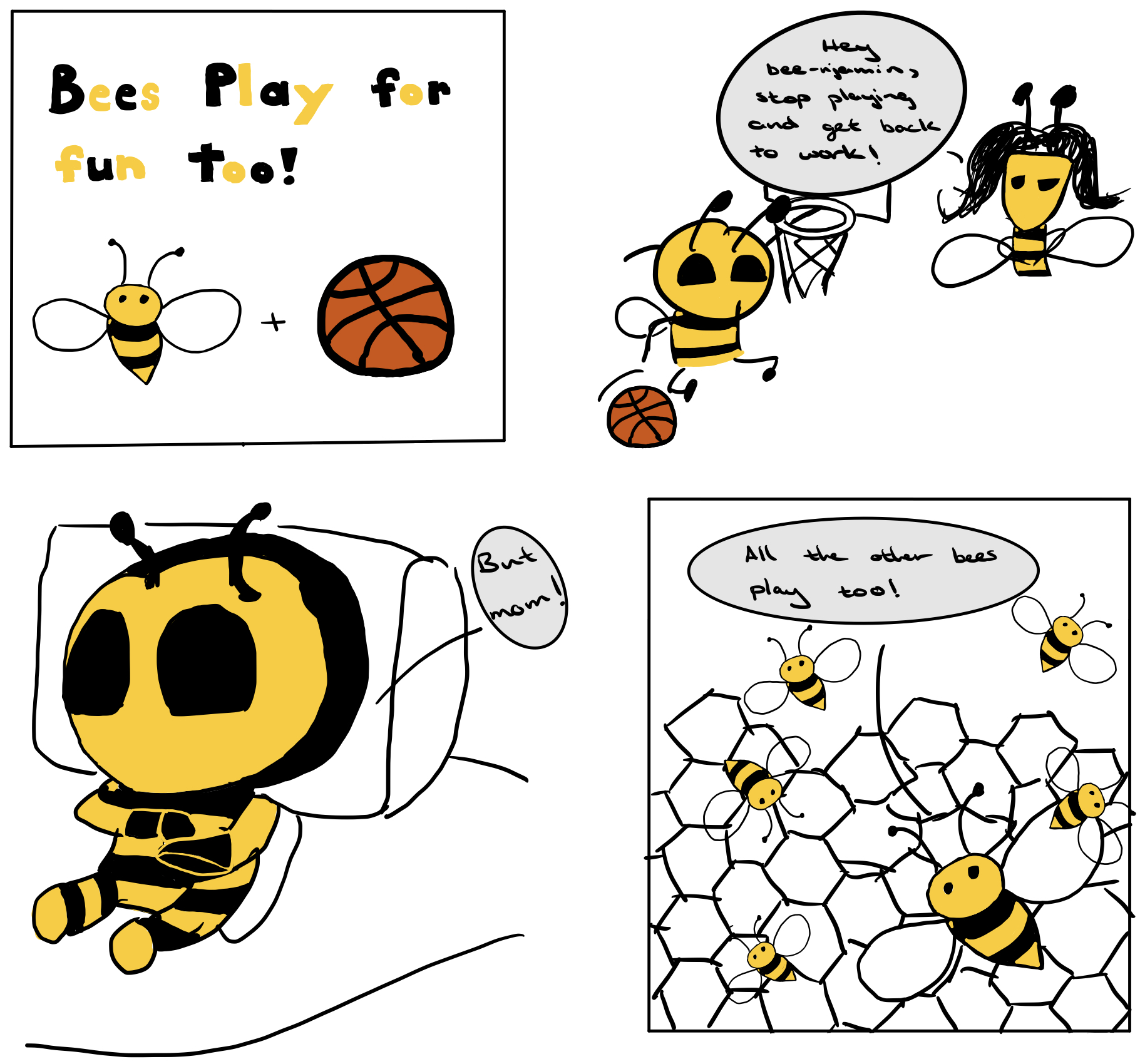
Do you ever wonder if animals think like us? While it’s not easy to tell, one study at Queen Mary University found that bumblebees like to “play” with wooden balls by rolling them around with their bodies. How do we know it was “play” and not something for survival?
“Play” in animals should be voluntary, spontaneous, or rewarding in and of itself. The act of “playing” is a behavior that doesn’t have any immediate benefit like mating, finding food, or shelter. In the study, 45 bumblebees were placed in an arena connected to a separate feeding area by a path surrounded by 18 colorful wooden balls. The route to the feeding area was clear, but the bees could leave their path and interact with the yellow, purple, and plain wooden balls, over the course of three hours every day, for 18 days. The balls were glued to the ground on one side of the path, and were free on the other. The bees- which were marked by age and gender, generally preferred the area with balls that could move around.
When I mean preferred, I mean they really liked being able to interact with the balls that were moveable. Some bees only rolled the balls around with their bodies once, but others did so up to 44 times during a single day, and one even went over to roll the balls 117 times over the course of the study! The fact that the bees continue to return to the balls and roll them “suggests that there’s something rewarding about it,” says lead researcher Samadi Galpayage.
Since the bees’ nectar and pollen (their food) could always be accessed in a separate room, there was no reward associated with going to the balls. The bees also never attempted to bite or extend their proboscis (a tube that extends from the head of the bee that acts similarly to a mouth) toward the balls in search of a sugary reward, meaning they didn’t confuse the balls for food. Also importantly, they came back to roll the balls a day or even two days after eating. This is important because in nature, bees can be observed to stray away from the flowers that no longer give them a sugary reward. The bees didn’t ever show attempts at mating—and they rolled the balls in all directions, meaning that they weren’t trying to clean up their living space, as they sometimes do.
Finally, the bumblebees didn’t get quicker at ball-rolling or show anything suggesting improvement in ball-handling abilities—another sign that the rolling was simply for fun. The fact that bees play means that they have at least some intelligence and when they’re not balling, they’re working hard to pollinate and maintain environments. Unfortunately, our bee friends are struggling to survive and we should try our best to protect them and keep them happy. But on a lighter note, next time you’re balling with your friends and your mom says it’s time to stop – say that she’s beeing unreasonable, even bees find time to play!
References
Galpayage Dona, H. S., Solvi, C., Kowalewska, A., Mäkelä, K., MaBouDi, H. D., & Chittka, L. (2022). Do bumble bees play? Animal Behaviour. https://doi.org/10.1016/j.anbehav.2022.08.013