
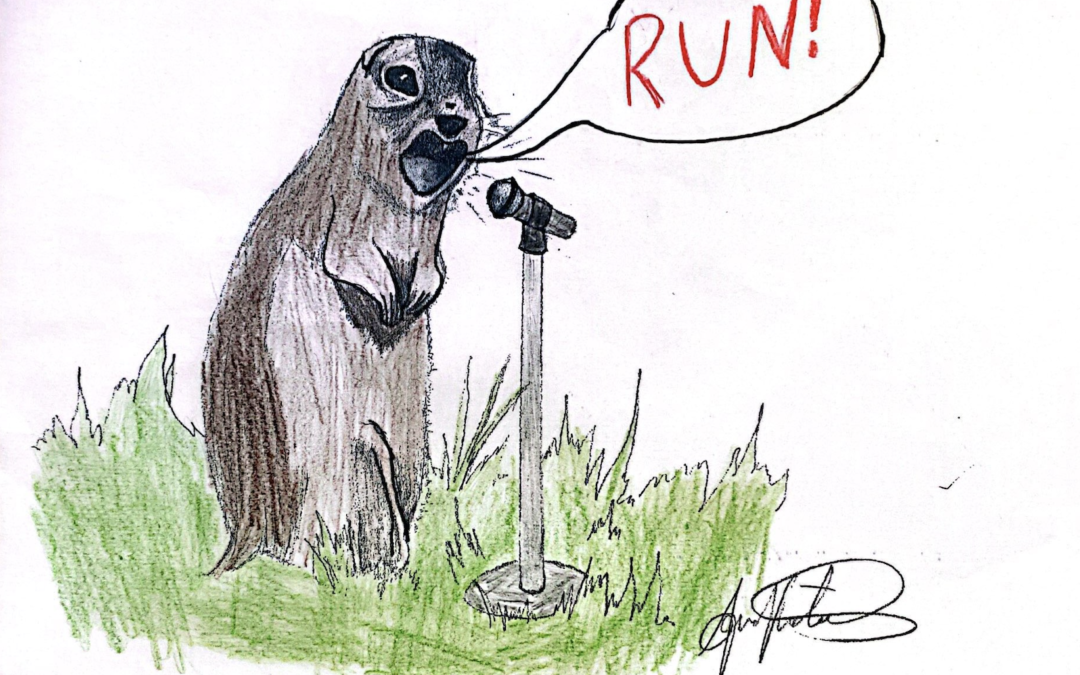
BOO! Did I scare you? I probably didn’t, but have you ever been so scared that you’ve let out a scream? Maybe it has happened after someone has snuck up on you? Or after a really scary part of a movie? If this has happened to you, you’re not the only one. In fact, many animals have “screams” that they use to alert others that they have seen a predator. One of these animals are prairie dogs (Cynomys gunnisoni). Prairie dogs make a variety of noises, but the one that is most important is their bark.
Prairie dogs are cute little animals that are a type of rodent. They live in the western United States and live in family groups together. These groups of prairie dogs have “towns” made up of burrow holes and tunnels where they eat, rest, and hide from predators. Their barks are important for protecting them from predators. When one of them sees a predator they start to bark, alerting all the other prairie dogs to run and hide in the burrow holes. Some scientists have become interested in these barks and two major questions have emerged. 1.) Do each individual prairie dog have a unique bark? And 2.) Do prairie dogs change their bark depending on what predator they see?
Researchers, led by W.J. Loughry, looked to answer these questions by recording the prairie dogs barking in response to different predators. The researchers caught and marked individual prairie dogs and then let them free. The scientists basically named the prairie dogs so they were able to track who “said” what. The researchers then tricked the prairie dogs by putting fake predators in their habitat. They did this by putting models of different predators on sleds and pulling them with a rope! They recorded the barks in response to the different predators and compared them in order to test their questions.
So what did the researchers find? First, they found that each prairie dog has a unique bark. It’s like how your voice sounds different from the voices of the other members in your family. These unique barks could hold a variety of information about the prairie dog’s personality and identity and prairie dogs may be able to recognize each other just by their voices! Second, they found that the prairie dogs do not have different barks for different predators. There is only one bark that they vocalize in the presence of any predator. I mean, do you blame them? If you had multiple predators that were trying to eat you, would you think about how you were going to change your scream?
So the next time you get a little too scared and scream, you can imagine yourself as a little prairie dog alerting others of predators and relaying information to your friends. Who knew a scream could say so much?!
References
Loughty, W.J., Oeser, M., Anderson, C.D., Hoogland, J.L. (2018). The importance of variation in the alarm calls of Gunnison’s prairie dogs. Animal Behavior, 150, 59-68. https://www.sciencedirect.com/science/article/pii/S0003347219300284
