
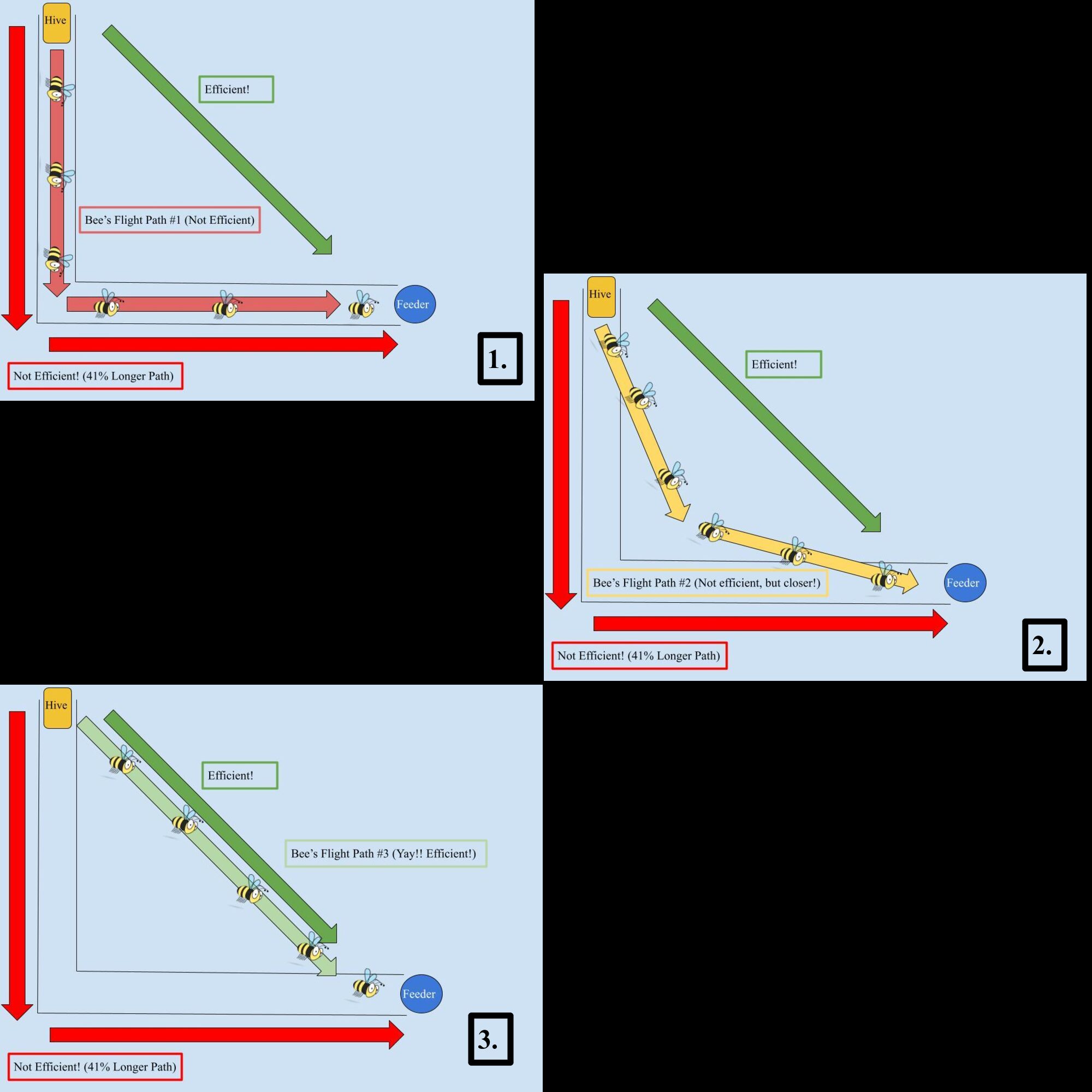
Have you ever gotten lost and had no clue where you were? What did you use to find your way? Chances are you either said a navigation system of some kind or a map on your phone. And while it is great for us, most animals do not have this kind of luxury. Animals must create their own maps and navigation systems in order to find their food, homes, and resources. One animal that has been found to be a particularly good navigator is the bumble bee. Bees are amazing in their ability to gather information, create mental maps, and communicate these maps to other individuals in their hives. Past research has proven the use of compass signals (The use of the sun as a compass) and skyline landmarks (Trees, buildings, etc.) in bee navigation. But what if there are no skyline landmarks? A recent study by Joanna S. Brebner and her colleagues found that bees use ground level, linear features (roads, paths, rivers) in their navigation in the absence of skyline landmarks. Bees are actually able to follow roads home. This research has considerable implications on how we understand how bees forage for pollen and how bees adapt their navigation strategies depending on the environment.
Bees were found to use linear features in both exploration (first) and subsequent foraging flights in the experimental environment. Two hives and three feeders were arranged along linear features of a flat and gridded rice farm. These linear features included roads, footpaths, and pathways. Bees had a tracker placed on them and were tracked individually using a radar. In their first flight in the environment, bees had a large bias for linear features, especially on flights back to the hive. This suggests that linear features are used for precise navigation in a new environment when the bee is close to the goal location. After exploratory flights, linear features were also followed when bees traveled from their hives to the feeders and back. This implies the use of some “memory” within the bees in order to follow a path to a goal location. Even when the feeder was removed, the bees followed these linear paths to the spot of the feeder. When the feeder was not found, bees began to follow adjacent linear paths in search for feeders, suggesting the use of personal experience in their search for food.
Interestingly, bees were found to be able to learn more efficient routes and rely less on linear landmarks as experience was gained. The researchers tracked an individual bee’s repeated visits to a feeder in which the most direct path would cut in between the linear features rather than taking the roads directly (see the above figure). In fact, taking the roads fully would make the path to the feeder 41% longer. Researchers found that initially, the linear features were relied on heavily in the navigation of the bee. In the first 10 trips measured, 60% of the flights were taken “the long way”. But as experience was gained, the linear features were followed less and less. In the last 11 trips only 14% of the flights followed the linear features, with the bee electing to take the efficient route. This implies that bees are able to learn more efficient routes and, with experience, rely less on linear guides for precise navigation. Bees are able to transition from taking the long way to quite literally being able to “beeline”. It’s like during the first couple days of school when it feels impossible to find where all your classes are. But, as the semester continues, you’re able to become comfortable and find all the shortcuts during your commute.
So the next time you see a bumble bee buzzing by you, think about how you’re watching one of the Earth’s smallest cartographers. Human’s understanding of this fact can help us drive the conservation of bees in allowing us to influence their movement in finding a suitable habitat.
References: Brebner, J.S., Makinson, J.C., Bates, O.K., Rossi, N., Lim, K.S., Dubois, T., Gómez-Miracho, T., Lihoreau, M., Chittka, L., Woodgate, J.L. (2021). Bumble bees strategically use ground level linear features in navigation. Animal Behavior, 179, 147-160. https://www.sciencedirect.com/science/article/pii/S0003347221002177
