
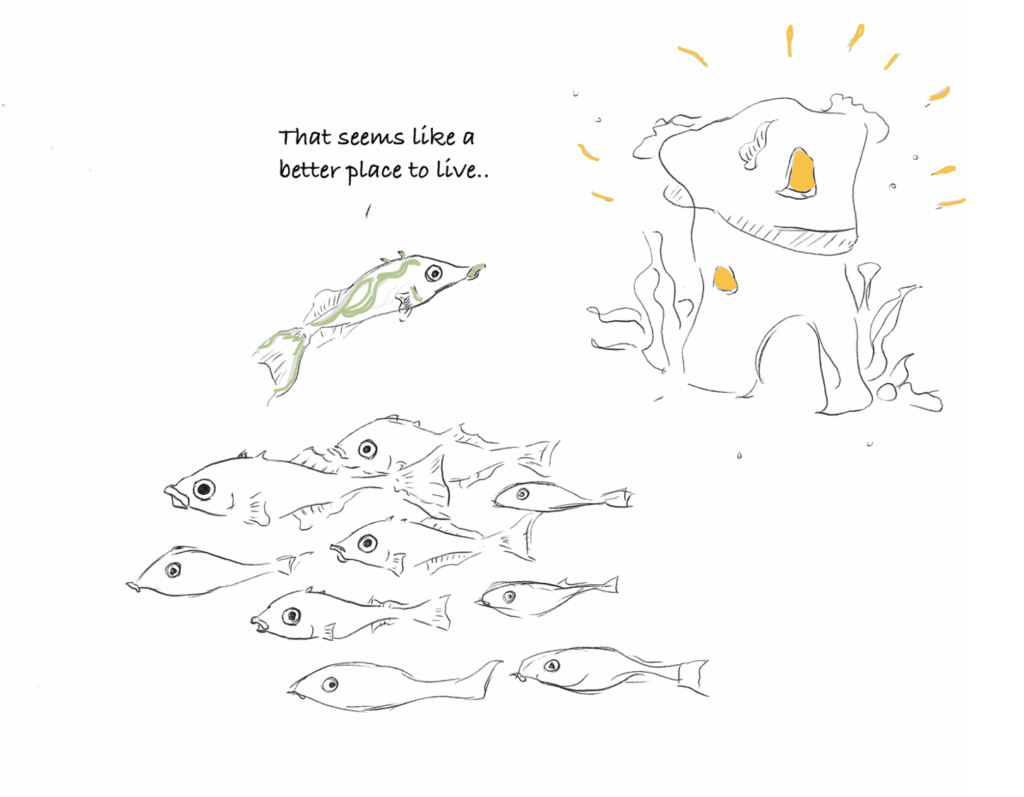
Figure1. That seems like a better place to live. Illustration by Richard Fu is licensed under CC BY-NC-ND 4.0
There are benefits for collaborating with a group: more information, complementary strengths, and ideally better decision making. Fishes live in a flock for the same reason we build communities and workplaces with groups of people. However, when the group gets too big, there can be drawbacks such as peer pressure and conformity that individuals are less likely to share their great innovative ideas.
Sticklebacks make better decisions regarding habitat in a medium-size group than larger nor smaller groups. Two scientists from Australia designed a circular water tank of which the center is a shallow platform undesirable to the fishes, and the outside loop is the more favorable deep water. Two habitats are separated by a plastic divider equipped with a remotely controlled door, and when they lifted the door, the sticklebacks can navigate and move to the better home as a group. Interestingly, the medium group (12-20 sticklebacks) makes the fastest exit from the unfavorable center within a minute, whereas the small group (2-10) and the large group (22-29) took much longer, almost 4 times longer than the medium group. It’s easy to comprehend why it took longer with a small group, since it takes longer for them to explore the space and gather information, yet when the group gets bigger and stronger, why didn’t they make better decision faster?
It is very likely that the disadvantages of group conformity occurred in their decision making. To initiate the group movement to the deep water, it takes a first innovative fish that embarks on that adventure. The medium group favors the innovator for they not only have more members to detect spatial cues, they are more confident with taking risks with the group strength. However, as the group exceeds the optimal number, they face a higher pressure to conform and a slower reaction span to respond. The cost of being the first innovative fish could imply forgoing the security and benefits of the group, and the bigger the group, the higher the cost. Also, the group adoption of a innovative behavior relies on the proportion of the group that has already taken that path. As the group gets larger, the “voice” of the first innovative fish can be easily neglected. And even if such a courageous fish made this innovative step, the larger body can remain very irresponsive.
Let’s appreciate group work but beware of the drawbacks of conformity. What is the size of your optimal medium group? Do you feel the pressure to conform?
Ward, A. J. W. & Webster, M. M. Mid-sized groups perform best in a collective decision task in sticklebacks. Biol. Lett. 15, 20190335 (2019). https://doi.org/10.1098/rsbl.2019.0335
