
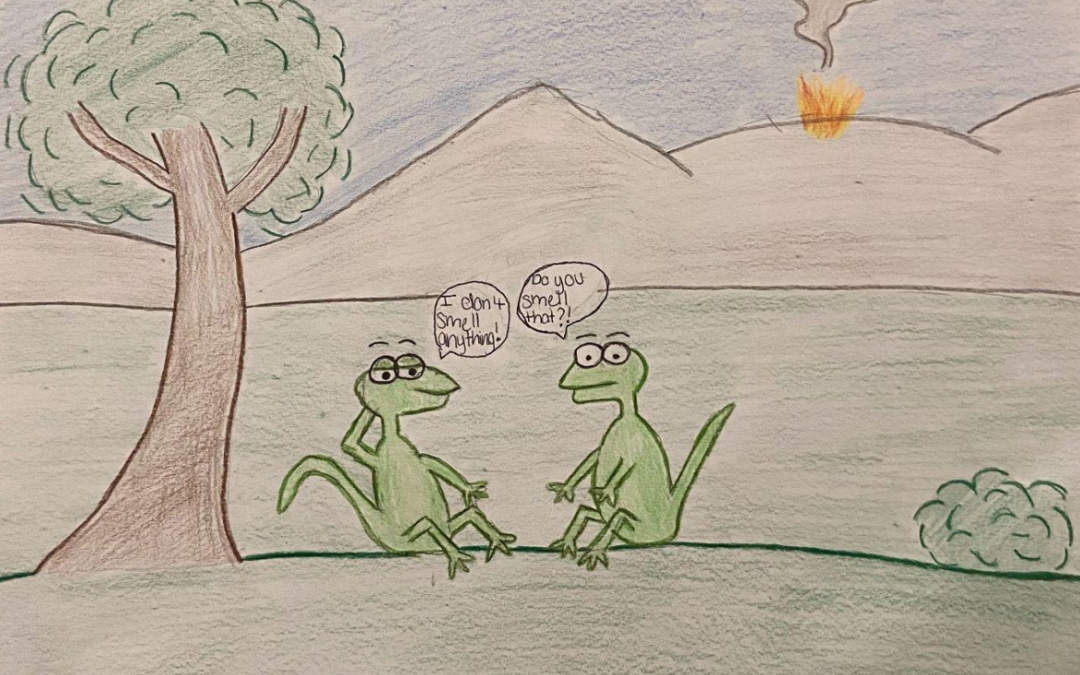
We all know what to do when there is a fire: stop, drop, and roll. But what about other species, how do they respond to the threat of a fire? The Algerian sand racer, a species of Mediterranean lizard, has inhabited many different ecosystems across the Mediterranean region. Depending on the physical characteristics and the species of plants that make up each ecosystem, some of these regions are prone to fire, while others are not. It was hypothesized by Álvarez-Ruiz and colleagues that lizards living in fire-prone regions will be better at identifying smoke as a threat, and will modify their behavior accordingly.
Much like us, the Algerian sand racer relies heavily on its sense of smell to gather information about their surroundings. In fact, these lizards are able to detect smoke through their sense of smell. Once smoke is smelled, the lizards will be able to respond accordingly, through behaviors such as fleeing, or finding a hiding place. In order to test whether or not lizards from fire-prone regions respond more strongly to smoke, researchers collected lizards from both fire-prone and non-fire-prone regions. Then, each lizard was placed inside of a terrarium and exposed to either real smoke, or a fake, odorless smoke (control). Researchers then observed the behavior of the lizards to determine whether or not they responded to the presence of the smoke. Standing still was not considered to be a response, while other activities such as running, walking, scratching, and tongue flicking were measured to determine the response of the lizard to the smoke.
It was found that lizards from the fire-prone-regions exhibited greater responses to the presence of smoke. In fact, 93% of the lizards from fire-prone regions displayed reactionary behavior to the smoke, while only 71% of the lizards from non-fire-prone regions reacted to the smoke. This is a great example of animals learning and adapting to their environment. By being able to detect and better react to smoke, the lizards from the fire-prone regions are able to reach safety faster when under the threat of fire. This allows the lizards to thrive in many different types of environments, which is important as we face an ever-changing world from pressures such as climate change. Just as we practice fire safety and have been taught to react accordingly by stopping, dropping, and rolling, lizards seem to also have their own fire safety protocol!
References
Álvarez-Ruiz L, Belliure J, Pausas JG. 2021 Fire-driven behavioral response to smoke in a Mediterranean lizard. Behavioral Ecology 32, 662–667. (doi:10.1093/beheco/arab010)
