
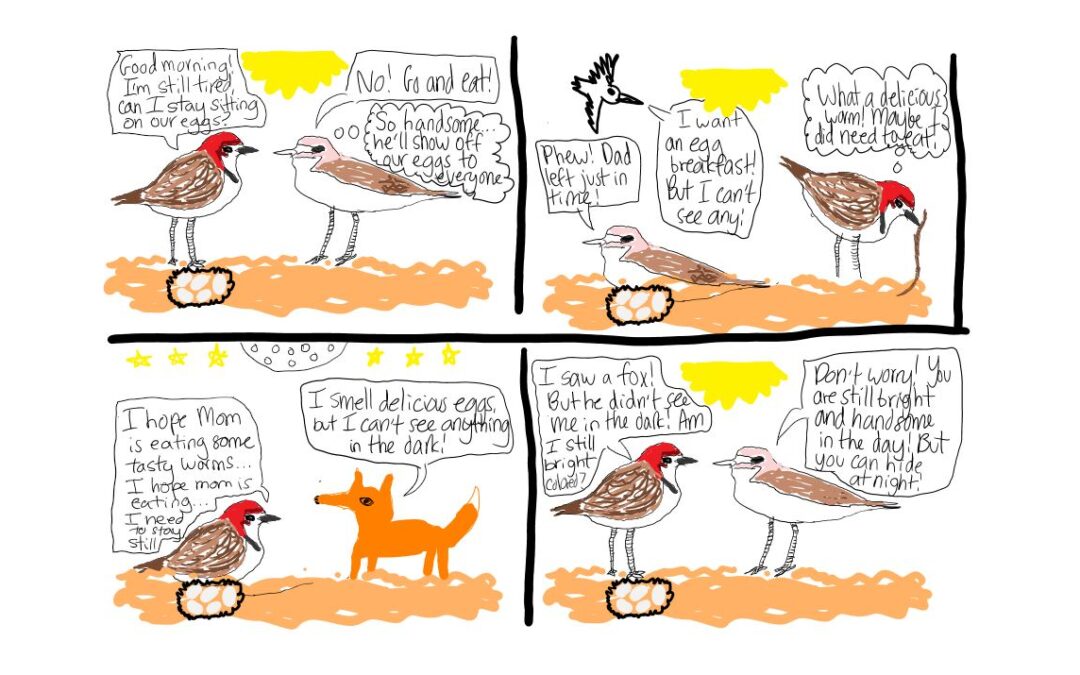
Figure 1. Red-capped plovers “conversing” about their breeding strategy. The plovers divide the work of incubating eggs based on their sexually dichromatic colors (the male is much brighter than the female).
The red-capped plover bird lives its entire life on the beaches and sandflats of Australia. Like any other species, they must raise young in order to continue their existence. However, it is a challenge to successfully hide their nests and raise young on a wide-open beach, like a good hide-and-seek player.
Eggs in a nest must always be incubated (covered and warmed) by a parent. Without incubation, they could freeze and die. However, a parent cannot sit on the nest for the entire day and night, as the parents must eat to maintain their energy and warmth. Thus, they both incubate and protect their nests.
The parent plovers must hide their nest from foxes and ravens. Foxes and ravens use their eyesight to try and find nests with tasty eggs or baby plovers to eat. Foxes hunt at night, and ravens hunt during the day. However, it is difficult for predators to see color at night – and this gives the plovers their fighting strategy in the game of life.
Male and female plovers look different. The male, to impress females, has a bright red top (called a “cap”) to his head. The female is dull brown colored. She is cryptic, meaning that she can easily hide by blending into the brownish beach background. The male is not cryptic, as he is easy to see on an open beach. His red cap makes him look like Waldo trying to hide in front of a brown background! The difference in color of the male and female plovers is an example of sexual dichromatism, which is a difference in coloration based on the sex (male or female) of a species.
The plovers use their sexual dichromatism to their advantage. Scientists measured that males visiting the plover nest during the day bring extra attention to their young. Since the males are so bright and beautiful, predators can look for a splash of red to find them. If a male plover is near a nest in bright daylight, the predators will find the nest by finding the male! During the day, the dull brown females incubate the nest, as they can still blend in with the background.
However, the male cannot incubate the nest for an entire 24-hour cycle. During the night, predators struggle to see any bright colors. Thus, male plovers protect and incubate their eggs at night, when their red cap is less visible. They eat during the day, taking care to stay away from the nest. Then, at night, the pair switches positions, and the female goes off to feed.
Scientists also noticed that bright females with lots of red on their heads can give away the location of the nest to predators. If the female plover is bright, the family may struggle to raise chicks, as the female plover cannot hide herself and the nest during the daytime. The plovers’ strategy of staying hidden will fail, and they will not produce offspring. Though this story is sad for the plover pair with the brightly colored female, their failure to raise children helps the entire neighborhood of plovers (called a population in animals). In the future, no offspring will resemble parents with extra-bright colors, so the plovers hiding strategy can continue to protect their young. In this way, sexual dichromatism helps the population of plovers survive into the future.
References:
Ekanayake, K. B., Weston, M. A., Nimmo, D. G., Maguire, G. S., Endler, J. A., Kupper, C. 2015. The bright incubate at night: sexual dichromatism and adaptive incubation division in an open-nesting shorebird. Proceedings of the Royal Society B: Biological Sciences. 282(1806): 20143026. https://doi.org/10.1098/rspb.2014.3026.
