
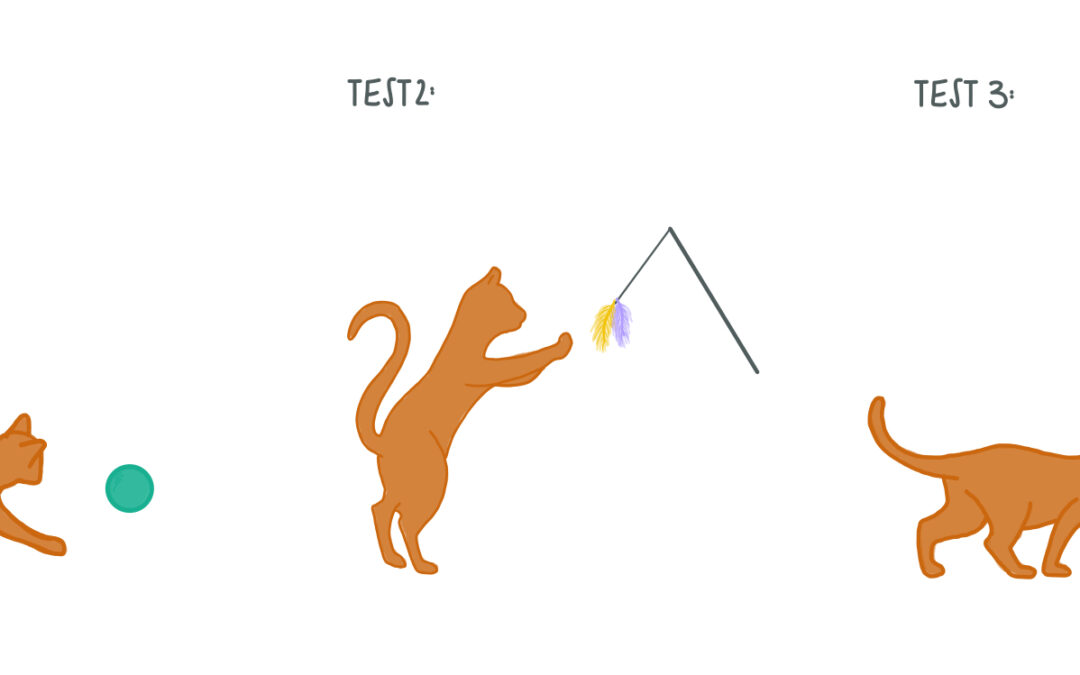
Do you have any pets at home? Maybe you have a dog, or a cat. If you have a cat, you might notice that they like to play with toys like balls or chaser wands. Cats that are allowed outdoors might even catch other small animals, such as mice or birds, and bring them into the house. These types of behaviors seen in pets are similar to predator-like behavior in wild animals. Predation is a form of hunting in which a predator, usually a larger animal, hunts for a prey, usually a smaller animal. Playing with toys, such as balls, sticks, or even other animals, are types of hunting behavior that can be found in house pets like cats and dogs. However, there is a difference in playing behavior between cats that only stay indoors compared to cats that are allowed outside. Not only is there a difference in playing behavior between indoor and outdoor cats, but also between cats that spent more time with their mothers as kittens.
In one experiment, cats were given a ball to play with and found that indoor cats moved toward the ball and began playing with it sooner than cats that were allowed outdoors. A second experiment tested the number of times cats were able to catch a chaser wand. Cats that were raised by their mothers for more than eight weeks caught the chaser wand more times than cats that were raised by their mother for less than eight weeks. Finally, a third experiment timed how long it took for cats to search for pre-recorded prey-like sounds, such as bird chirps or mouse squeaks. Indoor cats began to search for the pre-recorded sounds earlier than cats that were allowed outside. Indoor cats also spent a longer amount of time searching for pre-recorded sounds than cats that were allowed outside. Cats that were raised by their mothers for longer amounts of time also began to search for the sound earlier than cats that spent short amounts of time raised by their mothers.
The fact that indoor cats are more ready to play with toys than cats that are allowed outside might mean that indoor cats do not have a lot of experience with real prey. Cats that are allowed outside might have more experience with real prey, like mice and birds. These cats’ experience with real prey may mean that they are less interested in toys used for play. In addition, cats that spent more time being raised by their mothers were better at catching the chaser wand and began to search for pre-recorded sounds very quickly. This might mean that cats raised by their mothers for a short amount of time do not have enough experience watching play behavior and are worse at catching chaser wands and searching for prey-like sounds. Altogether, indoor cats play with their toys more than cats that are allowed outside, and cats that spend more time with their mothers as kittens may be better at hunting than cats that spent very little time with their mothers as kittens. These exciting findings might make you wonder “Should I let my cat spend more time outside?”
References
Pyari, M. S., Uccheddu, S., Lenkei, R., & Pongracz, P. (2021). Inexperienced but still interested – Indoor-only cats are more inclined for predatory play than cats with outdoor access. Applied Animal Behaviour Science, 241. doi:10.1016/j.applanim.2021.105373
