
Winter is a wonderful time of the year. Despite the bitter cold, you get to look forward to snow days, hot chocolate, and most importantly Christmas, with the arrival of Santa Claus. Everyone knows that when Santa Claus is coming to town, you better watch out, you better not cry, and you better not pout! I’ll tell you why! Behaving and being good before Christmas, guarantees that Santa is going to bring you presents, otherwise you get coal. Did you know that this behavior is actually caused by previous experiences? By being good in the month leading up to Christmas, you are acting a certain way because you know what is coming ahead of time; this is what we call an anticipatory behavior. Interestingly enough, humans are not the only species that act this way! A species of grass lizard has a similar behavior (well more or less, I can’t say whether they get excited for Christmas or not, but they practice anticipatory behaviors too)!
First we need to discuss the relationship between predators and prey. We know that a predator hunts for their food, also known as their prey, but this is not always as simple as it sounds. Prey do not want to be eaten, as much as the predators want them to! Prey have come up with unique strategies to help them avoid being eaten by predators and these strategies can sometimes be an anticipatory behavior. The prey has to use past experiences and signals around them to create their anticipatory behavior that allows them to avoid the predator, and this can differ from animal to animal.
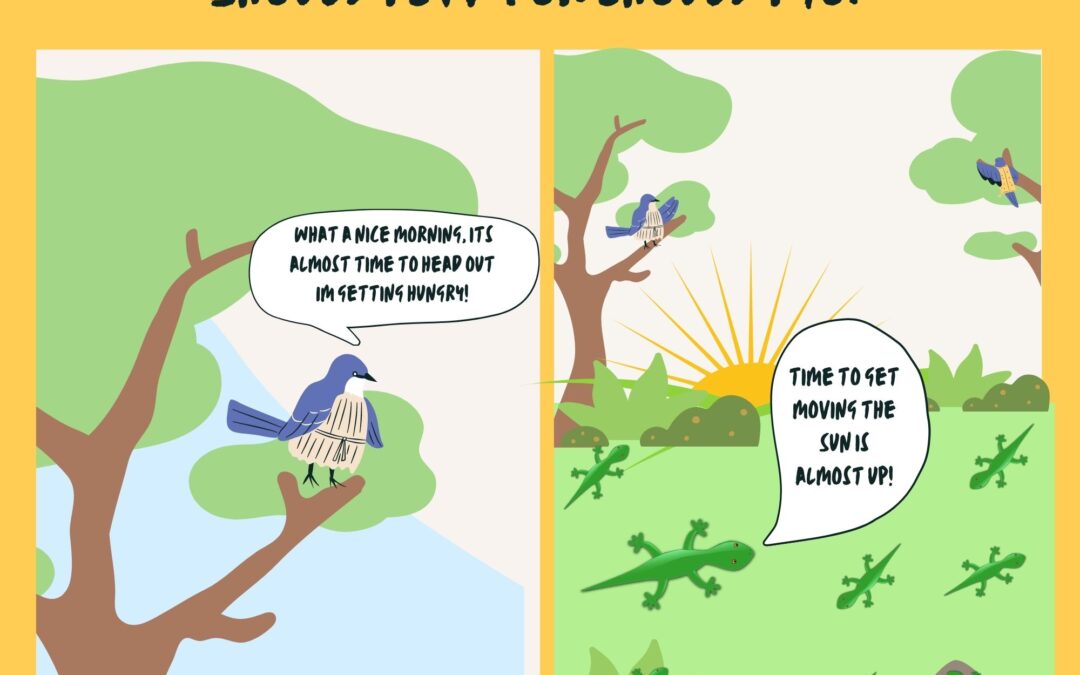
Researchers Chen et al. (2021) discovered that grass lizards (Takydromus viridipunctatus) move based on the time of day to avoid being seen and eaten by their common predator the egret, a type of bird. They found that lizards woke up and started moving around at the same time that the egrets prepared to leave their nests. Lizards started their movements at dawn, which is the time when the sun begins to rise. Additionally, the researchers found that dawn is the time of day when the eyesight of the egrets is its best for detecting the just noticeable difference between the grass perches where the lizards sleep and the lizards themselves. Upon moving, Chen et al. (2021) found that lizards quickly scatter from their perches to large clumps of grass because they are much harder to detect there.
Since the lizards are moving from their perch at the same time as the egrets are leaving their nests, we can say that there is evidence that these lizards are practicing anticipatory behavior! This is important to us because these anticipatory behaviors help us understand how predators can have an effect on decision making in prey. Without anticipatory behaviors, predators would win all the time which is not favorable for the prey because they would constantly be eaten and would risk being totally wiped out! Similarly, without behaving the month before Christmas, you would never get any presents and Santa would always be bringing coal, which is not fun for anyone! So this Christmas make sure you behave, and maybe now you will stop and think that you’re practicing the same anticipatory behavior that these lizards and so many other animals do too to survive! Pretty cool right!
References
Chen Chih-Wei, Whiting Martin J., Yang En-Cheng and Lin Si-Min. 2021. Do I stay or do I go? Shifts in perch use by lizards during morning twilight suggest anticipatory behaviour. Biol. Lett.17: 20210388. http://doi.org/10.1098/rsbl.2021.0388
