
Imagine waking up for school on a freezing cold winter morning. You dread leaving your warm bed and trekking out into the chilling wind and snow. At first the cold is biting and seems unbearable, but slowly the degree to which it bothers us decreases. Our bodies have the ability to change how they work to maintain our body temperature when we enter cold environments. For example, shivering helps create rapid movement in our muscles that warm us up. However, you can also alter your behavior to help keep your temperature stable in the cold. Humans often combat the cold by bundling up in layers of winter gear. This demonstrates how behavioral choices can help us survive in changing conditions.
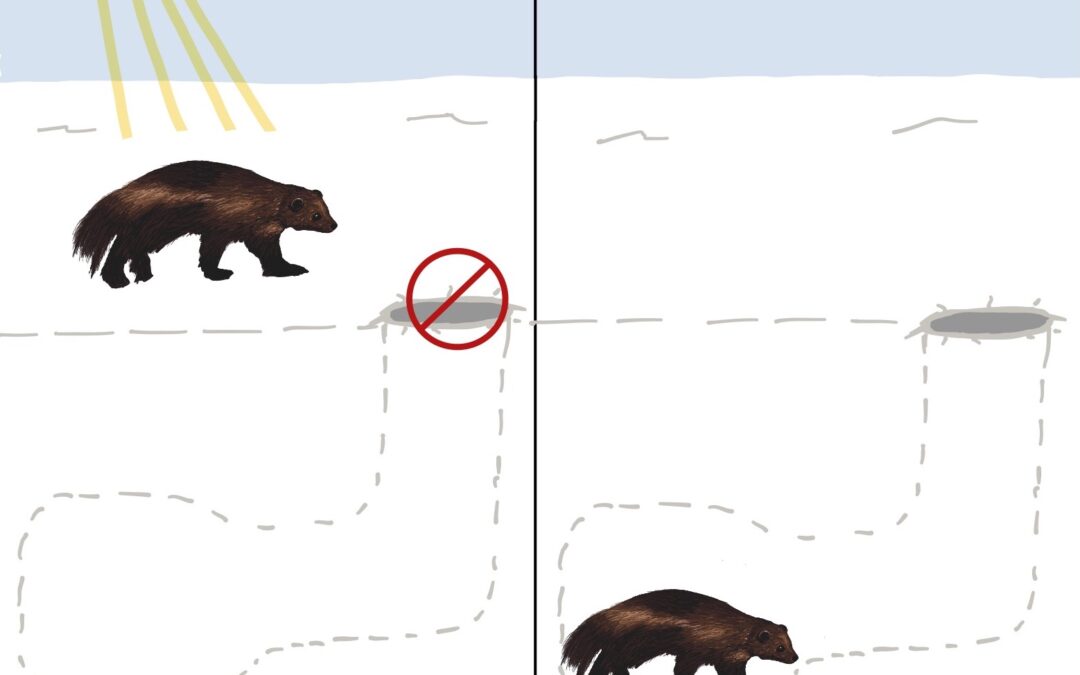
Humans are not the only species that change their behavior in response to the temperature outside. It has been seen that wolverines also use different behavioral strategies in their varying habitats. They use underground snow cavities for reproduction, protection, and food storage, especially in the winter months when excess snow provides improved structure and insulation. Additionally, they use these cavities for rest, but they can also choose to rest above the cavities on surface beds. However, resting on surface beds puts them at a greater risk for predation by grey wolves.
A team of scientists led by Thomas Glass set out to discover how wolverines, a mammal well adapted to cold environments, choose where to rest throughout the day. Do they prefer underground cavities or beds atop the snow? They wondered if selection of resting sites might be influenced by the temperature and amount of solar radiation experienced at the site. They also were curious to see if predation risk had an effect on resting site choice.
They found that 51% of the time wolverines chose to rest in snow cavities. When the temperature above the surface of the snow was -40℃ wolverines exclusively rested in the cavities and when temperatures were above 5℃ they exclusively rested on surface beds, regardless of solar radiation levels. Generally, time spent resting on the snow surface increased as temperature and solar radiation increased.
Despite their increased risk of being preyed upon, wolverines still choose to rest upon the snow surface in relatively warmer, brighter weather to help maintain their body temperature. However, the wolverines displayed much more vigilance on the surface since they are more exposed and easier to prey upon. Overall, the authors concluded that wolverines would rather conserve energy by using their environment to help maintain their body temperature than try to avoid being seen by predators.
This study helped advance the field of animal behavior because it provided more evidence for the existence of energy and behavioral tradeoffs. In this particular case, the wolverines could either maintain their temperature or avoid predators. This study also gave insight on habitat selection and survival in a species that has not been heavily studied.
Glass, T. W., Breed, G. A., Robards, M. D., Williams, C. T., & Kielland, K. (2021). Trade-off between predation risk and behavioural thermoregulation drives resting behaviour in a cold-adapted mesocarnivore. Animal Behaviour, 175, 163–174. https://doi.org/10.1016/j.anbehav.2021.02.017
