
When you think about how honey bees defend themselves against predators, you might think of the classic example of a bear getting swarmed and stung by hundreds of bees. But how do they fend off smaller, more fierce foes, such as the Asian hornet, which have sting-resistant armor and are nearly three times as large as the worker honey bee.
The most common (and most clever) way these bees fend off these hornets is by using a technique called ‘bee-balling.’ Bee-balling is when hundreds of bees surround an invader (or sometimes their own queen, but that’s a story for another day) and rapidly vibrate their wings. This raises the temperature of the hornet to a piping hot 40-47°C (104-117°F). Remarkably, some species of hornets are able to survive these high temperatures.
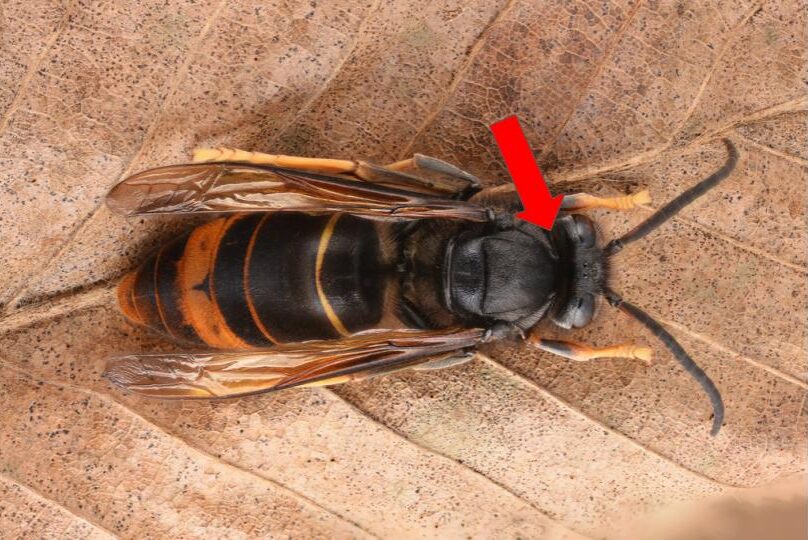
Thankfully for the bees, the Asian hornet’s armor may not be entirely as sting-proof as we had thought. Much like a knight in armor, there appears to be some exploitable weak spots in their defenses. The ‘neck’ (called the veracervix) of the Asian hornet (Figure 1) lacks the sting-resistance that the rest of the body has, allowing the honey bees to inject their venom into the enemy. And, as it turns out, bee-balling and the injection of venom work better in conjunction with one another.
In early 2021, Gu and colleagues discovered that the rate of hornet survival at bee-balling temperatures decreases from 75% to ~10% after just one sting. One idea put forward by the researchers is that the increased temperatures from bee-balling cause the venom to quickly spread throughout the hornet, becoming more deadly.
In any case, this is amazing example of how honey bees use what they have available to them and exploit their enemy’s weaknesses to take down enemies much larger than themselves.
References:
Gu G, Meng Y, Tan K, Dong S, Nieh JC. 2021 Lethality of Honey Bee Stings to Heavily Armored Hornets. Biology 10, 484. (doi:10.3390/biology10060484)
