
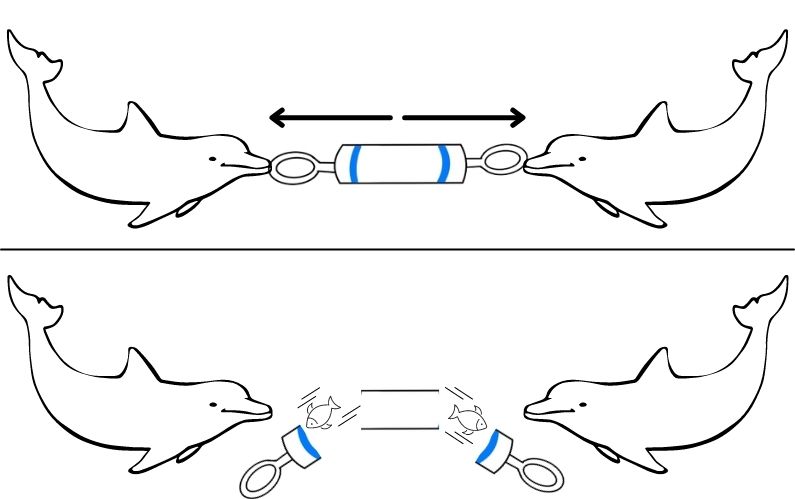
A common challenge faced by many dolphins in captivity is, quite simply, being bored. While bottlenose dolphins who live in the wild have many other dolphins to mingle with, ample amounts of space to swim, and the opportunity to learn in a giant ocean, dolphins kept in captivity do not have the same opportunities. In fact, many dolphins kept in captivity suffer not only from boredom, but also from stress and frustration.
Luckily, animal behavior researchers have come up with a possible solution. They created a toy for two dolphins named Domino and Molly. The way the toy worked was simple: there were two pieces of rope, one on each side; if both were pulled at the same time, the toy would open, revealing a delicious, fishy treat for the dolphins. So, what did the scientists discover? Sadly, only Domino was interested in this toy, while Molly did not seem to pay much attention to it at all. So, the human partner played the role of another dolphin! When Domino would bring the toy to the human and bite down on the rope, he or she would simply hold the other side of the rope, allowing Domino to pull it open with his or her help. Interestingly, they found that Domino showed a behavior known as “insight learning”. This simply means that the dolphin was not taught how to open the toy to access the fish inside. Instead, Domino had a sort of “eureka” moment where he just figured it out by himself!
Although the scientists behind this study explain that this toy should make dolphins cooperate with each other, there is also the possibility that the dolphin was just playing tug-of-war and not necessarily trying to help get the device open––at least, the first time he was given the toy. Nevertheless, this device, and others like it, seem to make the lives of captive dolphins better, as it gives them an opportunity to solve problems and learn social skills.
Matrai E, Ng AKW, Chan MMH, Gendron SM, Dudzinski KM. Testing use of a potential cognitive enrichment device by an Indo-Pacific bottlenose dolphin (Tursiops aduncus). Zoo Biol. 2020;39(3):156-167. doi:10.1002/zoo.21536
