
Imagine you are playing hide and seek outside with your friends. You run around trying to find a suitable hiding place, while the seeker counts down before coming to get you! You find the perfect hiding spot behind a tree, but since you don’t look like a tree, you need to blend in as best as you can. In an attempt to look like the tree, you raise your hands above your head to mimic the tree’s branches and stand very still. Because you fit in with the tree in front of you, the seeker looks right over you and moves on to find your friends. This is an example of postural camouflage.
Camouflage is often used in the wild to help animals blend in with their surroundings, so that they are less likely to get eaten by a predator. Some animals use colors and patterns to blend in with their environment, and some sit very still or change their behaviors to fit in. Others position their bodies in a way that mimics the objects around them to avoid being found by predators. This is called postural camouflage because animals are posing like something around them, using their body’s posture (body position) to their advantage. Postural camouflage is the placement of a body or body part in a way that makes it difficult to find the organism. This may involve acting like a stick or a leaf on a plant, or sitting still and mimicking a rock or some other part of the environment.
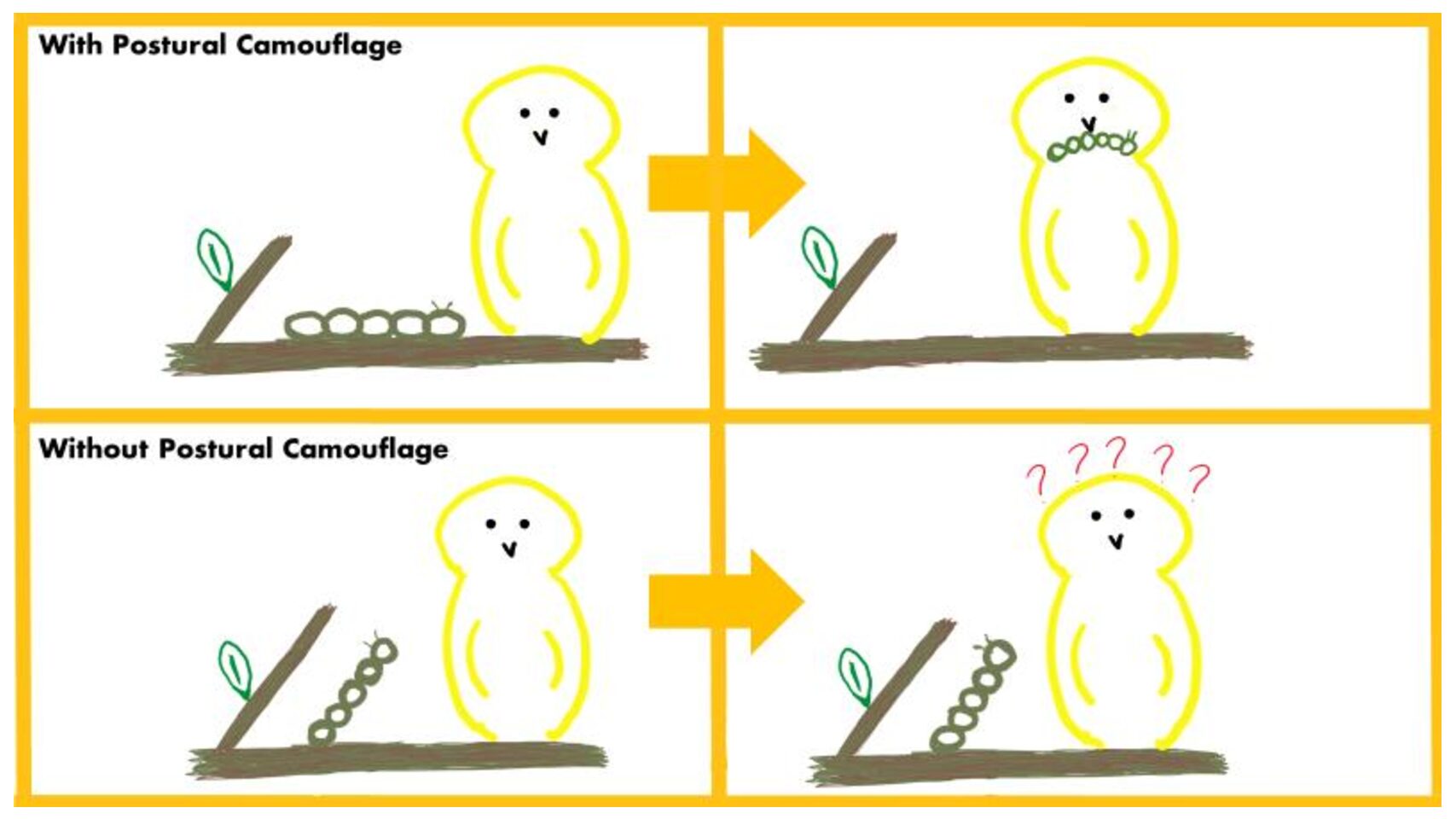
Recently, work was done to explore whether or not postural camouflage actually gives an advantage to the animals who try to avoid getting spotted by predators. In 2020, a group of scientists used peppered moth caterpillars to answer their questions about postural camouflage. Peppered moth caterpillars avoid predators by mimicking the twigs on tree branches, hoping to fit in with their surroundings. They are able to hold their bodies up for long periods of time while a predator searches for food near them. Using birds who were trained to hunt for caterpillars, the scientists measured the survival rates of camouflaged caterpillars compared with caterpillars who did not try to blend in. They found that it took the birds much longer to find the caterpillars who looked like tree branches than it did to find caterpillars who were not posed (Figure 1). This shows that postural camouflage works! In addition, caterpillars who were hungry and cold were not able to hide as effectively from their predators. The scientists concluded that well-fed caterpillars are better at postural camouflage than hungry caterpillars, and therefore are less likely to be eaten by hungry predators who are confused by their twig-like appearance. So next time you play hide and seek, remember to use your arms and legs to mimic the objects around you to camouflage yourself as best as you can!
References:
Rowland, H. M., Burriss, R. P., & Skelhorn, J. 2020. The antipredator benefits of postural camouflage in peppered moth caterpillars. Scientific reports, 10: 1-8. https://doi.org/10.1038/s41598-020-78686-4
